Good Luck Jeff James

Friday was a sad day at the Petri IT Knowledgebase. It was the last day for Jeff James, the Editorial Director. You might not know Jeff’s name, but if you’ve worked in the Windows world you’ve seen his results:

  • Jeff was Editor-in-Chief at Windows IT Pro and TechNet Magazine
  • He was a key player in bringing Paul Thurrott to Petri
  • The reinventing of Petri.co.il was Jeff’s work
  • And Jeff gave me the change to blog professionally

Jeff announced last week that he was moving on, and joining HP to work on their social media. Things are going great at Petri, with lots of credit going to Jeff, but he had found an tough-to-turn-down opportunity that is close to home. Anyone who is a customer of HP has won a great ally and I’m looking forward to seeing the results over the coming years.

Jeff, I hope things go great and thank you for what you’ve done for me and the readers of Petri.com.

Some Thoughts & Comments From WPC 2015

Here are some things that I thought were noteworthy from Microsoft’s Worldwide Partner Conference 2015 in Orlando this week. Keep reading even if you don’t work for a Microsoft partner, because this stuff affects anyone working in the Microsoft world.

These may be paraphrases because I wasn’t taking precise notes.

“Cortana is everyone’s assistant”

Not it’s not, when on the phone (the most mature version) it’s only supported in 10 countries. You can make it work internationally by screwing up your regional settings. This is what we call The Curse of Zune.

“I love my iPhone”

The Microsoft employee that said this live on a keynote stage was summarily executed backstage. Holy crap on a cracker!

“Cortana Analytics ….. <Snores>”

See The Curse of Zune. I’ll care when Cortana is relevant.

“Cortana Analytics will help businesses all over the planet”

Uh, no. It’ll help the USA at first, and then a max of 10 countries. Don’t believe me? Check out … I dunno … history.

“Sea Otters!!!!”

Apparently, this is why 12,000+ Microsoft partners flew to Orlando this week, according to Terry Myerson. Strange, because Sea Otters are native to the Pacific coast.

“Laissez le bon Windows rollez”

My reaction to Bryan Roper’s Windows 10 demo. OK, he’s Cuban-American and not cajun, but that’s what I thought (and tweeted) at the time. Best demo of Windows 10 I’ve seen yet, and LOVED the energy. The hat beats the hair, easily. We need more Roper in keynotes.

“Microsoft to expand its Surface distributor count from a couple hundred to a few thousand worldwide”

This is huge news. It means nothing to most people, but for the last 3 years my employers have said “sorry, we can’t sell that” over and over and over. To finally open the sluice gates through the channel to business, Microsoft’s new $1 billion business could double or treble in a year.

*Yawn*

Seriously, Microsoft, trim those keynotes down to 2 hours. Down … to … two … hours. Oh my!

“Soon you will see premium Microsoft phones designed for Windows 10”

Nice timing – I’m due an upgrade from my provider. Me wanty Continuum.

“CSP program to include Azure, Enterprise Mobility Suite (EMS) and CRM Online, in addition to Office 365”

Again, means nothing to most of you, but this opens up a joint syndication channel to end customers via the channel. It’ll simplify purchasing, and force big changes in the channel too.

“New sync engine coming to OneDrive for Business”

This is badly needed. Two reasons I hear from partners that use DropBox with customers instead:

  • Constantly failing sync that is costly to repair
  • Problems with file path limitations

“There will be 5 more #Azure regions opening in the next few months”

Wowzas! South Korea is rumoured, though Finland was too. India is to come online with 2 regions before the end of this year.  Canada is getting two in 2016 (Toronto and Quebec City).

“Microsoft cloud partner competencies shifting to adoption instead of sales”

Competencies are the incentive-based expertises that partners must qualify to achieve. One measure has been amount of associated licensing sold to the partner’s customers. This is changing, as it it internally with Microsoft’s sales people, from monetary value to adoption. This is to counter “shadow sales” of cloud services that are more like sneaky discounted inclusions in volume licensing deals rather than requested purchases.

“WPC 2016 will be in Toronto”

Start camping out for your sessions now. The reviews that I heard of of the last WPC in Toronto were horrific – big crowds, tiny rooms, and few people able to attend sessions.

“You’ve got to have technical people dedicated to keeping up with Azure”

Keeping up is my job. It’s impossible for one person to keep up. Either have a team of subject matter experts that have time allocated to do this, or get serious about attending regular tech updates. And this isn’t just Azure, it’s EVERYTHING Microsoft from 2 years ago onwards.

“We’ve got to become more technical”

Microsoft COO Kevin Turner told this to partner sales people, account managers, owners and Microsoft subsidiaries, many of which have drained away technical roles over the last 5 years. Fact is, folks, Azure is a technical sale. No solution design, no pricing, no sale. Please move on.

“Continuum is my favourite feature of Windows 10”

Satya Nadella agrees with me. If Continuum-capable flagship Windows phones can be put into the hands of enterprise users with Office 365, then we have a game changer. But Microsoft needs to fix the channel. Their fascination with telecoms companies ha crippled the phone. Even Apple is selling unlocked phones via distribution now.

Microsoft News – 16 July 2015

It’s been a busy week with WPC driving announcements that affect partners.

Hyper-V

Windows Server

Windows Client

Azure

clip_image001

System Center

  • Datazen Enterprise Server: Datazen Enterprise Server is a collection of web applications and Windows services. Acts as a repository for storing and sharing dashboards and KPIs.

Office 365

Licensing

Miscellaneous

Approaching Windows 10 Availability

This is an exciting time in time in a Windows version’s life cycle. We’re just 2 weeks away from initial availability and things are starting to appear or shake up. The Verge (and everyone else) is reporting that Microsoft has selected Build 10240 (divisible by 16, which is important, oddly) as the RTM build. That doesn’t mean it’s the RTM build. Microsoft has released this build to Windows Insiders for testing, and I guess that RTM will happen soon.

When? I suspect that Microsoft will very quietly (via a blog or a tweet by Gabe Aul) announce RTM tomorrow (Friday 16 July) or on Monday, letting the noise of WPC subside.

But that leaves manufacturer just 2 weeks (availability starts on July 29th) to get hardware ready!?!?! Don’t stress. There’s two approached that OEMs are taking. When I say that it doesn’t mean that an OEM is going down just one road; they might have different approaches for product lines.

Approach 1: Up to Date

We’ve heard that HP has hardware coming out for Windows 10 before Windows 10. The machines have been tested and developed with the preview builds and when a user gets the machine home, if they have Windows 8.1 they will get the free update to Windows 10.

Approach 2: Wait and See

This is how most OEMs are taking it from what I hear. They’re not going to get stressed – let’s face it, Windows 8.1 hardware will work better with Windows 10. These OEMs will not release hardware with Windows 10 on it for a while.

In fact, you won’t see hardware with Windows 10 on the shelves (except for Surface, possibly) for quite a while. This is because it takes quite a while to:

  • Ramp up manufacturing
  • Physically move stock by ship from China (or nearby) to the rest of the world
  • Pass the stock through the warehouses of manufacturers and distributors and then into resellers hands

And for some stupid reason, some OEMs launch new stuff via exclusive contracts so even the channels can be very restricted.

But the excitement builds. Soon we’ll see MDT, Windows Update for Business, SCCM updates, documentation updates, group policy stuff … … ah then fun!

Technorati Tags:

MS15-068–SERIOUS Hyper- V Security Vulnerability

This is one of those rare occasions where I’m going to say: put aside everything you are doing, test this MS15-068 patch now, and deploy it as soon as possible.

The vulnerabilities could allow remote code execution in a host context if a specially crafted application is run by an authenticated and privileged user on a guest virtual machine hosted by Hyper-V. An attacker must have valid logon credentials for a guest virtual machine to exploit this vulnerability.

This security update is rated Critical for Windows Hyper-V on Windows Server 2008, Windows Server 2008 R2, Windows 8 and Windows Server 2012, and Windows 8.1 and Windows Server 2012 R2. For more information, see the Affected Software section.

The security update addresses the vulnerabilities by correcting how Hyper-V initializes system data structures in guest virtual machines.

I don’t know if this is definitely what we would call a “breakout attack” (I’m awaiting confirmation), one where a hacker in a compromised VM can reach out to the host, but it sure reads like it. This makes it the first one of these that I’ve heard of in the life of Hyper-V (since beta of W2008) – VMware fanboys, you’ve had a few of these so be quiet.

Note:

Microsoft received information about this vulnerability through coordinated vulnerability disclosure. When this security bulletin was originally issued Microsoft had not received any information to indicate that this vulnerability had been publicly used to attack customers.

It sounds like a reasonable organization found and privately disclosed this bug, thus allowing Microsoft to protect their customers before it became public knowledge. Google could learn something here.

So once again:

  1. Test the patch quickly
  2. Push it out to secure hosts and other VMs

[Update]

Some digging by Flemming Riis (MVP) discover that credit goes to Thomas Garnier, Senior Security Software Development Engineer at Microsoft (a specialty in kernel, hypervisor, hardware, cloud and network security), and currently working on Azure OS (hence the Hyper-V interest, I guess). He is co-author of Sysinternals Sysmon with Mark Russinovich.

image

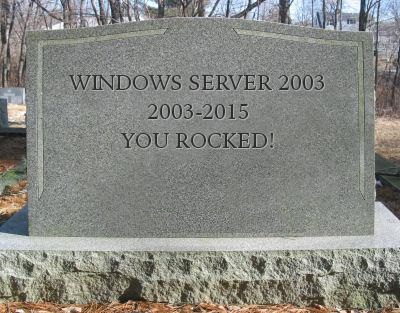
Windows Server 2003 End of Life

Today is a sad day; it’s the last day that Microsoft supports Windows Server 2003, Windows Server 2003 R2, and the related SBS versions.

The year was 2003 when I joined a spinoff of Hypovereinsbank called Hypo International, a finance company that would later try to crash the European economy (allegedly). HVB was stuck in the past running NT 4.0 Server and Workstation with Office 97. I worked in the HQ of the new company and was responsible for designing our global Windows network. I argued for Windows Server 2003 which had just gone GA, and I won out, and we deployed Windows XP on the desktop. We were going to be bleeding edge, doing all things by the book, and eventually we even ran what would become System Center to centrally manage the entire network. But powering it all was my baby, W2003. W2003 proved to be rock solid.

But times changed, as did the whims of the directors who attempted to move the IT department to Stuttgart (the new CIO later expressed to me how wrong a decision this ended up being) and I was made redundant. Work places changed, how we worked changed, W2008 came and went, W2008 R2 came and went, WS2012 came and went, WS2012 R2 arrived, and now we have a technical preview 2 release of WS2016.

So today, July 14th 2015, is the last day that Microsoft supports the aged W2003 and derivatives. The date was not a secret so there are no excuses. Fare thee well Windows Server 2003, and I look forward to working with your great, great, great grandchild in 2016.

Attempting to justify your stubbornness on not upgrading from W2003 on this site leaves you open to intense public derision and ridicule.

Technorati Tags:

WPC 2015–Day 1 Keynote

A video about YouthSpark. Way to talk to partners. promote YouthSpark where there’s free licensing and partners get zip. Then there’s a performance with people drumming on ladders.

Phil Sorgen

He comes out wearing a brand new partner scarf. Congrats go out to the partner of the year winners. Oooh it’s like the Olympics!!!!

IDC says that cloud business will be $200 Billion by 2018. There’s the agenda. Cloud. Get with it or get out. They’re sharing 20 scenarios with best practices for Azure/cloud deployment.

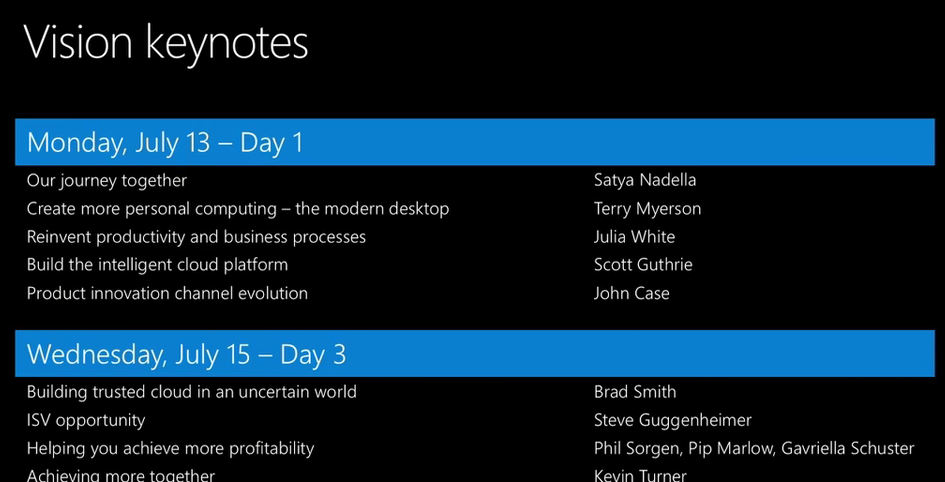
Here is the keynote agenda for this week:

image

User/cloudiness/mobility fluff. Then Windows 10. Then speed dating with Office 365. Red Shirts talking about Azure, and then something about productizing the cloud.

Now on to a Cortana video. Everyone outside the USA can sleep now. Zzzzzz ….

Bt seriously, they do stress the change in partnership and public opinion of Microsoft under Satya Nadella.

image


Satya Nadella

What makes Microsoft unique is the partner ecosystem.

image

Customer expectations and technologies have changed, but Microsoft uses WPC to reaffirm their commitment to partners. He wants to set out the mission and strategy with an anchoring ambition.

Mission: Empowering every person in every organisation to achieve more. They went back into their history to discover a sense of purpose (a PC on every desk in every home, etc). Now it’s … mobile first cloud first world. There is no other ecosystem that is solely built to enable customers to achieve greatness through digital technologies. They care about individuals and organisations, and they view the intersection of these as critical.

Some key attributes to mobile first, cloud first. We’ve heard this stuff before so I’ll get something to drink.

Ambition 1: Reinventing productivity and business process: bring together collaboration, communications, etc. This is O365, Dynamics, etc, an integrated set of extensible tools. Current solutions on-premises have created barriers to productivity. Microsoft wants you to use their tools in work and in life.

Julia White

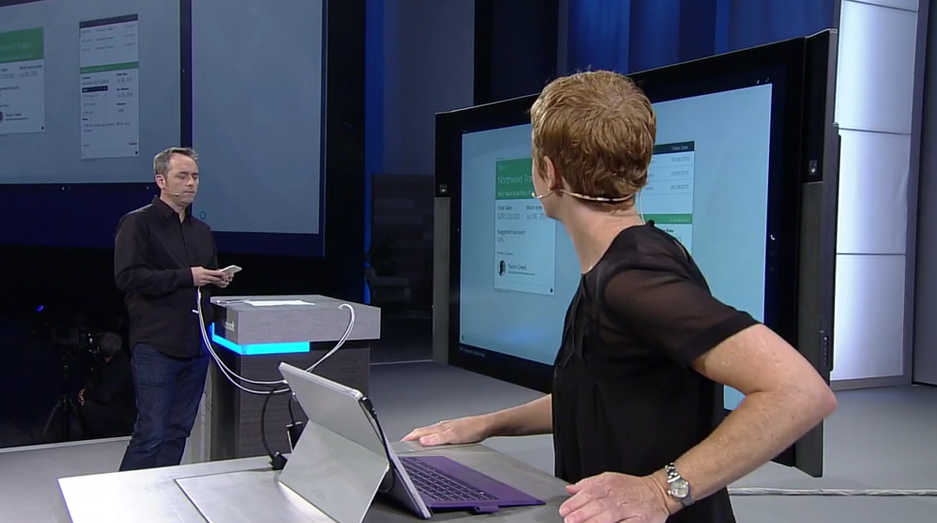
Scenario: customer might be leaving. Julia needs to work with Steve. Julia opens Gigjam to an empty Canvas. Cortana integration for the USA. They query information on the customer. They pull in emails with the customer onto the canvas. She draws a circle around stuff on the canvas, and draws an X on stuff she doesn’t want to share. Julia can see her entire data, and Steve can only see the selected subset. They share stuff on Surface Hub and on iPhone.

image


Demo gods kick them a bit, and eventually they get stuff shared properly to the iPhone. Steve “loves his iPhone” – yes, a Microsoft person said that. Steve shares some of the product roadmap from another service with Julia. She is seeing information from an app she doesn’t have access to. On a Surface Hub, all their shred data is on screen so they can collaborate. Julia shares stuff with another guy, who is automatically called on Skype. He shares some info and gets out of the call/meeting. Julia delegated stuff to another person. That person generated information, Julia review it, and shares it.

This was something new. It wasn’t communications; it was work sharing. There was no screen sharing; it was data distributed by an app.

Satya Nadella

Ambition 2: Building an intelligent cloud.

image


Usual message here. There’s more Cortana shite for the 4% of the world that lives in the USA. There’s talk about “any organization on the planet” but Cortana works in 1-10 countries only.

Ambition 3: Personal computing. Windows 10 will usher in a new eara of more personal computing. Continuum will transform our usage of devices. I 100% agree. The phone is already the #1 personal device. Windows Mobile 10 can make that device your PC …. but will people end up using iOS or Android instead when similar features arrive there? Microsoft needs to put Windows Phone handsets into business users, IMO, and that means serious changes to their channel.

Lorraine Badeeen

Here’s a demo of how AutoDesk 3D modelling can work on HoloLens. To test a design they normally create a slow and expensive 3D print. Now they can use HoloLens with their same design workflow with the same tools. On goes a HoloLens. There’s a small motorbike on Dan’s desk. He can change the bike directly on the model using his mouse. He can make it small or big with the wheel. He moves the  bike around. They have a real bike on the stage. They overlay a new design onto that bike. They change the colour schemes.

image

Above is the overlaid bike. He adjusts the mirror sizes.  The image is incredible. A remote team leaves notes on the bike, requesting design changes.

Satya Nadella

Satya winds up his presentation. Some intellectual property is shown for a couple of minutes, and we are shown a video of Sea Otters. I am not kidding.

image

Terry Myerson

Myerson says that “this video” is why we are here today. Sea Otters! Winking smile

July 29 when Windows 10 becomes broadly available is just a few weeks away. On that day, around the world, people will not get to use Cortana. Oh, sorry, Microsoft will be asking the world “what will you upgrade” and by that, they mean community efforts. They want to celebrate the people who empower others.

Sea otters.

Lots of old stuff rehashed. Out comes Bryan Roper with a hat. I guess he’s Cajun or something. He’s very cheerful. Laissez les bon Windows rollez. Less than 6% of users use ALT + TAB. Who is this dude and where has Microsoft been hiding him? This is much better than the usual dull Windows 10 demo. Real time co-authoring in Word 2016. This will be even great for partners when writing a proposal with multiple authors. Oh it all goes wrong when he demos Cortana. I tune out.

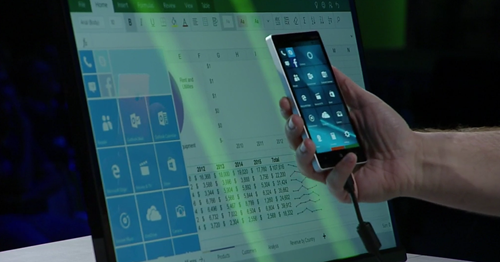
Now there’s a live demo of Phone & Continuum. He’s editing an Excel spreadsheet on a monitor using keyboard and mouse, off Excel running on a phone. That’s made possible by the Universal Apps platform.
image

A familiar HoloLens holographic apartment appears. The demo is identical to what we’ve seen before.

On to security. Virtual Secure Mode (Enterprise edition) of Windows 10 secures secrets using silicon and Hyper-V. Modern hardware enables modern security features. Roanne Sones comes out to talk devices. She starts off on IoT. There’s a demo of DeviceGuard, preventing a USB drive being put into a POS system that policy only allows to use USB retail hand scanners. Another demo: a micro-kiosk – the things used in the USA for credit card signing. To “hack” it, you open it up and steal the system media card. She pops it into a PC card reader and the drive is encrypted using BitLocker – the software cannot be compromised via out-of-band. She’s created her own malicious card instead. She plugs it into the micro-kiosk, and the boot fails. Secure boot has locked down the boot process so only signed images that the business owns can boot up.

The Anomaly console in Azure shows that there were problems in the micro-kiosk. The IT pro can investigate the device.

image

Back to Terry. He starts talking about selective patching. A new solution is needed. Windows 10 has a “flexible” update model that works with all kinds of devices. Windows as a Service provides continuous security and feature updates. Users can opt into rings. Some want to be first, some want to be cautious. Those who go first will be the “testers”. Windows 10 Enterprise will have the “long term servicing branch” for things like industrial devices. Here you want just security fixes, and lock down features for stability. End user devices at work want the innovation they see at home and IT pros need control. Windows Update for Business will offer this balancing act… handling rings, blackout periods (for sensitive times) for free – feature and security updates.

That’s a wrap from him. Now a video about the word changing and innovation.

Julia White

I have not a hope of keeping up here.

There is an E5 plan of Office 365 coming, along with a cloud PBX. Bring-your-own key is coming to O365. SharePoint 2016 is code from the cloud, and is being designed for hybrid solutions. OneDrive for Business … lots of new stuff – I hope that includes the sync engine. Ah – there is apparently, along with auditing, reporting, and DLP. The OneDrive consumer experience is coming to it. All this in H2.

image


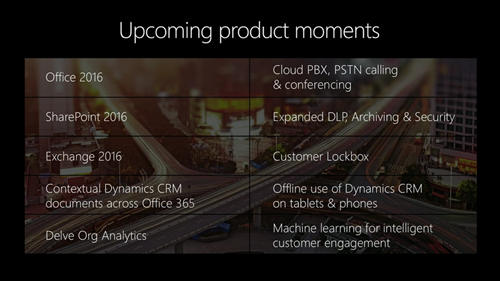
A demo of Delve, and content from external services like SalesForce is present there. Delve is based on Office Graph. Seems quite similar to what we saw at Ignite. New stuff coming in the next year:
image

Scott Guthrie

Here comes a barrage of new Azure features in a red shirt. He’s going to talk about Satya’s 2nd ambition to build an intelligent cloud platform.

image

Customers will look to SaaS for faster time to value. IaaS and PaaS will offer opportunities to re-engage with customers and improve business processes.

There will be 5 more Azure regions opening in the next few months. Over 3200 solutions in the Azure Marketplace.

image

Great numbers, but remember that adoption are not sales. Some partners are brought out to talk about the different kinds of solution they are deploying for customers in the Microsoft cloud: open source in the Azure Marketplace, PowerBI, and cloud reselling (Rackspace). I catch up on lost sleep. We’re over 3 hours now. The coffee just isn’t strong enough.

They’re pushing the CSP program, which isn’t a surprise.

We have just crossed the 3 hour mark. 1 more presentation left.

John Case, Corp VP Office Division

He has 4 major announcements in 10 minutes. I bet he goes over. It is 4:49pm right now.

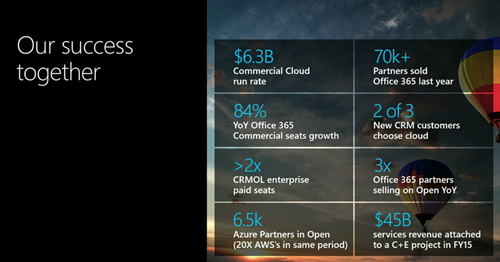
Some stats on Office, CRM, and Azure:
image

Azure has 20x more customers in Open than AWS has in their similar program. Azure in Open launched August 1st of last year. The channel is in upheaval. The best partners in O365 are at 1.5x revenue over standard partners, and have higher margins, etc.

  • Announcement 1: CSP is expanding. It launched last year. It now includes O365 (as it did originally) and now includes Azure, EMS, and CRM Online. It’s going to 131 countries, and includes commerce APIs.
  • Announcement 2: New incentives to drive active usage. Cloud competencies are shifting to usage from sale – similar to what MSFT did internally with sales. Being involved with a sale is not good enough anymore – partners must deploy technology and drive usage. Customers will get dashboards for O365 and Azure to see per-workload usage of customers.
  • Announcement 3: A new hybrid cloud competency –  “Azure certified for hybrid solutions”.
  • Announcement 4: A new Office 365 E5 suite is coming in the next year. Cloud PBX, Skype PSTN, lockbox, etc are all coming in E5. E3 sales are a tiny percentage of O365 sales, so this should be interesting. E4 is pointless in most countries because of lack of telecoms support. So E5 … hmm … I think SKUs might get merged sometime down the road.

I guess lots of people left before now. He thanked people that stayed. And he wraps up at 5:02 PM, 13 minutes after he started, and 3 minutes over the promised 10 minutes.

John announces that WPC 2016 will be in Toronto. Lead balloon. No applause. Why? The reviews on the venue from the last time were terrible. The rooms at the venue were too small and feedback from people I know was that they wasted a week there because they got into so few sessions. I wonder if Microsoft can tear up that contract?

And that’s a wrap.

WPC – The Conference That Shapes Your World That You Don’t Know About

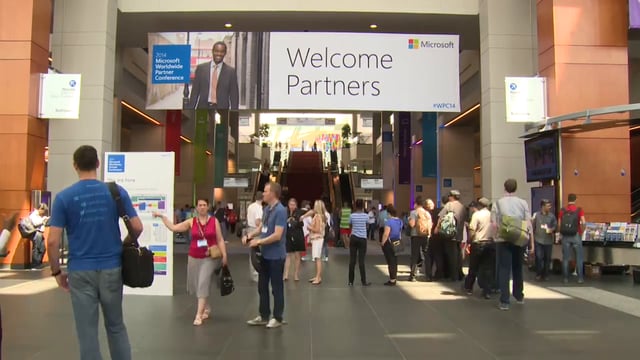
Today is day 1 of Microsoft’s annual conference for partners, WPC, aka Worldwide Partner Conference. At 1:45 PM (UK/Irish time) the day 1 keynote will begin and Microsoft will lay out their agenda for the coming year.

Events such as Build and conferences such as Ignite are where Microsoft talk technology. WPC (for Microsoft partners) and MGX (for MIcrosoft sales employees) are where they talk business. Today, we can expect Satya Nadella to take the stage and talk fluff about mobility of user experience, productivity, and services for several hours.  Tomorrow, COO Kevin Turner will fire up the troops and talk numbers and competition. He’s the guy overseeing the score charts that dictate Microsoft’s subsidiary business, so his voice is pretty important. There’s usually little news here, but sometimes there are interesting market share facts.

But in the midst of all the usual catchphrases, rapidly delivered demos by Julia White (breath!) and at various breakout sessions this week, Microsoft will talk about some important stuff. And this is the stuff that affects company strategy, licensing, and what Microsoft/partners will be talking to your boss about in the coming year. This is what I expect to be pushed:

  • Adoption, adoption, adoption: Microsoft used to recognise and measure sales of products. But in the era of the cloud, adoption is more important. There’s been many sneaky includes of cloud services in volume licensing deals to make red lights green, and Microsoft is stopping this.
  • Azure: It’s still really early days for Azure in the partner market. Will they sort out some of the pricing issues and deal with partner concerns like central management, and transitioning from MOSP (direct) billing subscriptions to Open?
  • Office 365: It’s been a huge success in Ireland, but not so in the rest of Europe, or in the USA I hear. Again, lots of people “bought” it but didn’t buy into it.
  • CSP: Microsoft will be putting a big push on Cloud Solution Provider as a new means to resell and distribute cloud services via “tier 1” and “tier 2” partners. There are serious issues with CSP, such as partner-provided 24*7 technical support and lack of subscription transitioning.
  • Surface & devices: What news will there be? Will Microsoft finally fix the one business problem that Surface has? Answer: a viable channel to business. You wouldn’t believe how much Surface business we turn away because of Microsoft’s own stupid rules.
  • Windows 10: This one will be tricky. As a distributor, Windows 10 is bad news for us (free is bad when you’re in the business of selling). I think Microsoft will encourage partners into selling deployment projects. I think partners will be looking for ways to block Windows 10 until business owners say they want it. BYOD is an American thing (source: IDC).

Don’t expect anything of value on Windows Server or System Center.

BTW, this would be a nice time to announce the RTM of Windows 10. But really, I expect this to be a blog post, maybe on Friday morning (10-11am) Redmond time.

Technorati Tags:

Microsoft News–13 July 2015

I don’t have all that much for you, but the big news is the Azure Site Recovery (ASR, Microsoft’s DR site in the cloud) now supports VMware virtual machines and physical servers, without using System Center. You do need to run some stuff on-prem and in the cloud to make it work though, so there will be a tipping point where the solution becomes affordable.

Azure

clip_image001

System Center

Office 365