Thank You Mark Minasi @mminasi

A friend of mine, and a man who has influenced many IT careers around the world, is retiring. This week, Mark Minasi was at the Microsoft MVP Summit in Bellevue/Redmond to say farewell to many of his friends from across the globe. I’m taking this opportunity to say “thank you”.

I’m in a position to be able to write this post partly because of Mark. I’ve written before that 5 years into my IT career I found myself at a point where had to reinvent myself. I realised that relying on my employer to educate me was hopeless. I had to educate myself and put in the extra effort. I learned that continuous learning was the key to continued success. A few years later, in 2003, I landed a dream job, with the opportunity to design a Microsoft infrastructure that would span sites across North America, Europe, and Asia. I had a good idea of what I wanted, but I wanted more information, especially because I had decided to base everything on the just-released Windows Server 2003.

I believe in being prepared, so I went to a local book store and picked up two Windows Server 2003 books, including the infamously huge (1800 pages) Mastering Windows Server 2003 by Mark Minasi. I poured over his book for a weekend, pulling the pieces that were relevant and building out a design. A few months later, we went live, and it was gooooood.

There’s always Q&A about new things or problems, so I went online to find a place to ask questions. Mark ran a forum at the time and I joined. At first, I asked questions, but over time, that moved from asking questions to answering questions.

In 2004, my boss asked how I wanted to spend my training budget. I didn’t want to sit in Microsoft training classes because I knew that stuff. Instead, I wanted deeper information. I found a conference called Windows IT Connections that was running in Lake Las Vegas, and I signed up. There I saw great speakers like Jeremy Moskowitz (I bought his GPO book from him there, and it was amazingly detailed), and Mark Minasi. Mark’s sessions were interesting because he delivered information and entertainment all at once. His consulting work lead to more interesting topics, like understanding how AD replication worked in multi-site environments, the process of password changing, account lockouts, etc. These were all things I had to engineer around, and the information was more than one could find anywhere else.

I arrived early for one session, and sat in the fourth row. I was early and minding my own business. Mark came in, got himself set up, and then started to visit with the early birds. He came over to me and said hi. We talked about his one previous visit to Ireland, when he did some training in Galway. I didn’t tell him that I was “joe elway” on his forum – I thought that was being a bit weird.

A few years later, the membership on the forum became more and more friendly. The regulars were getting to know each other and chat about non-IT things. Some even knew each other from attending conferences. I don’t remember exactly how it started, but it was decided to arrange a meetup, which evolved into a mini-conference ran in Mark’s home town of Virginia Beach. That mini-conference saw some great minds attend, and share their knowledge. It was here that I got to know Mark personally, and he became a friend and great influence.

Myself, Mark Minasi, and Nathan Winters, on my “stag” photography trip to the Saltee Islands [Credit: Jimi Vigotty]

Mark had a genuine desire to see the attendees excel in all ways, whether it was at their techie job, or in the community as writers, speakers, etc. He freely shared his knowledge and experience.

One year, Mark taught a class on how to deliver a technical presentation. He talked about the preparation, the delivery, how to speak, etc. In technical audiences, there can sometimes be a difficult person: an ego that must prove itself as the best, a desire to be disruptive, or a hater of what you are saying. Mark shared his technique for dealing with that person – identify them while you are setting up before the presentation, and then go down to visit with them. Disarm the person by being friendly before the presentation … hmm 😊

When I think back to that mini-conference and the forum, the collection of people was impressive. One is leading huge Office 365 migration projects around the world. Another is at the tip of the spear on Microsoft’s global push of Azure Stack. A few of them were the best minds in Active Directory, inside or outside of Microsoft.  Another was a PowerShell guru, another a Small Business Server genius, and many of them became conference/user group speakers, and eventually became Microsoft MVPs.

A few of us discovered that we shared the hobby of photography and we start to go on trips together. We started by doing these trips before/after the conference in Virginia Beach and that became dedicated trips. I started to blog and do presentations. One year, Mark commented on my writing and encourage me to do more. And that became an offer to contribute to his latest Mastering Windows Server book – I was going from reading this series to writing this series! I wrote a number of chapters and my name was in the cover. That was a wow moment in my career. From that came other offers, and then I went to being the lead author on a few books, including the two Hyper-V books.

Mark’s advice on writing was to assume nothing about the reader. Explain the subject at a high level, introduce it, add some advanced content, and then cover the monitoring & troubleshooting. That’s the approach that was used in the Master series of books, and it’s something I adopted for my writing style.

My writing eventually lead to an offer to write for Petri.com. The editor back then came from Windows IT Connections (it’s a small world) and he wanted me to use my style or writing to explain Microsoft’s often confusing messaging in the Hyper-V and Windows Server context, and that migrated into Azure subject matter.

The offers for speaking kept coming, and Mark was always offering advice. He thought I should speak at, what was then, TechEd. There’s a longer story, but I eventually did get into TechEd Europe and the first Microsoft Ignite and, thanks to Mark’s advice over the years, I got great scores. I’ve spoken at many events and webinars. At work, I found myself writing and delivering larger and more complex training, eventually becoming 1-, 2-, and 3-day courses.

For years, Mark has been telling me to start doing my own thing. He reckoned that I should have been travelling Europe and the US, teaching Hyper-V classes. I didn’t really have the confidence that I could make that work but he always told me that I was silly to lack the required confidence. He was certain that people would attend. Last year, my wife said the same thing. Last year, I started Cloud Mechanix, and last month I taught my first Azure training course to a full room in London. Next month, I teach my second class in Amsterdam.

Mark’s influence on me changed my career. He’s always been a supporter, and encouraged me to do more. I know I’m not alone in that either. What he’s done for me lead to me asking him to be one of my groomsmen when I got married and I was honoured when he said yes.

That’s just my story. I’m certain that probably dozens of other people have similar stories of how Mark Minasi has impacted them. Mark has attended the Microsoft MVP Summit this week to say farewell to many friends because he has retired. I’ve seen some of that – people are coming up to say “hi” and “thank you”. I don’t think he can walk down a hallway without someone stopping him – it’s a nod to his impact on so many of us working with Microsoft products.

Mark, if you ever read this, thank you on behalf of me and the many that you have helped or influenced at your classes, the events you have spoken at, or via the books and articles you have written over the last 4 decades.

Aidan 2, Vodafone 0

If you follow me on social media, you might have noticed my escalation (phase 2) against Vodafone Ireland to get my issues resolved or my contract cancelled. I wrote a post, which was a diary of my costs and difficulties in trying to get a normal phone service from the telecoms company; I’d been without mobile data or text services for 10 days (11 including today). I tweeted Vodafone Ireland, to let them know what was to come. This morning, I escalated:

  • I posted to the Vodafone Ireland forum on Boards.ie (a huge forum in Ireland), and responded to every relevant article with my story.
  • I repeated that process on Vodafone Ireland’s own support forum.
  • I replied to every tweet by Vodafone Ireland, including their support tweets – I was about to configure Microsoft Flow to do that for me … that sort of makes this a tech story, right?

By 10:45, things started to happen.

I got the complaint reference number that I’d first asked for on the 19th of Feb (today is the 26th).

By the way, Vodafone blocked me on Twitter straight after that message. That was pointless – I can easily see every message using a second account (I have a few for various things). That was effectively an admission that I had an impact, and would only cause me to escalate.

Armed with the complaint reference number, I opened an official case on the Vodafone site, and then contacted Comreg. They normally have to wait 10 days after a complaint case starts, but after explaining the delay by Vodafone (I have all the screenshots, as you can see in these posts), the regulator offered to backdate the 10 days.

While I was talking to Comreg, a DM arrived in from Vodafone, at 10:54. Apparently some engineers had finished the break they’d started 11 days ago, and were able to look at my case. I rebooted my phone and …. tah dah! … I have data and text services once again.

So what’s the lesson here? Good customer service is cheaper than what a motivated and pissed off customer will do to you. I’d say at least 20,000 people saw what I did, and that stuff will stay on the Internet forever. And that was only phase 2 of my 3-phase plan. I was willing to purchase Google Adwords and advertise on Facebook to do more damage! I’ve bent Vodafone to my will twice, Eircom (now Eir) wrote an apology letter to me once, a debt collector (sent illegally by Eircom for a non-existing contract) apologised to me on the phone, saying I’d never hear from him again, and I made a camera store in the UK apologise and refund me after some dodgy payment practices. Be willing to use the voice that you have, and punish bad customer service. Poor customer service works for bad companies while they save money and you are willing to live with it. When you cost them money by damaging their reputation with the truth, they have to capitulate.

How Bad is Vodafone Ireland’s Mobile Phone Service?

Let me tell you a tale … a tale of a contracted-for and paid-for service mobile phone Internet & SMS/Text data services that Vodafone Ireland is failing to provide me with.

The Outage

This tale of woe starts on Thursday 15th February. I was on the road to visit a client in Limerick (I live in northern Kildare). I’d pulled into a service station and wanted to check to see what podcasts or audio books I had to listen to on the long drive. And I found that I had no Internet access. It’s not unusual to have blackspots so I ignored the inconvenience. Near the client site, I pulled in and opened my phone to navigate my way there because they had recently moved. And now, in Limerick City, I had no data services, even though I had a full 4G or 3G signal. Hmm! I made my way there anyway, and texted my wife … and the text failed to send. So I had lost all data services: Internet and SMS. Maybe it was a network glitch.

I left 5 hours later and I still had no service. I drove home, verified that I could browse on my wi-fi. I still had no data services when just on the Vodafone Ireland network. I made my first call.

Vodafone Interaction #1 (Day 0)

I got home and called “Customer Care”. I explained the issue clearly and patiently. I rebooted my fairly new iPhone 8 several times as requested. After about half an hour, I was told that either my phone was broken or the SIM needed to be replaced. There was “nothing else” that could be done.

My wife, also with an iPhone and also on Vodafone, came home. We swapped SIMs. My SIM (my Vodafone Ireland account) in her phone wouldn’t work. Her SIM (Vodafone Ireland account) in my phone did work. That meant:

  • My phone was fine.
  • Either my SIM or my Vodafone Ireland account was at fault.

Replace The SIM (Day 3)

On Sunday 18th February, I finally had time to visit a Vodafone Ireland store – a 1 hour round trip. I walked in and quickly got a replacement SIM. I got home, swapped the SIM, rebooted and …

The problem was still there. The services that Vodafone Ireland are contracted to offer and paid to do were still not available:

  • Data
  • Mobile.

Costs that will be invoiced to Vodafone Ireland:

  • Mileage: 42 miles * €0.75 = €31.50
  • Hourly rate: €350

Vodafone Interaction #2 (Day 3)

Immediately, after that, still on Sunday 18th February, I called “Customer Care”. I must have spent 45-60 minutes explaining the problem and rebooting the phone as requested. Eventually the agent said there was nothing more he could do for me.

Finally, I thought, my case would be escalated to an engineer. Remember now, this is Sunday. This is when the agent informed me that, yes, my case would be escalated, but an engineer wouldn’t be looking at my problem until Wednesday at the earliest. 3 days!

My problem here is that I needed my phone on Wednesday. My business, Cloud Mechanix, was running a training class in London on Thursday/Friday and I would be travelling on Wednesday. This just was not going to be good enough.

This is when I told the “care” agent that at this time, Vodafone Ireland was no longer offering me the service I had contracted for and paid for. I demanded a release from my contract. I needed a service, and if Vodafone Ireland would not offer me my mobile broadband and texting services, then I would have to get these services that my business needs from elsewhere.

The agent flipped. I repeated myself several times. Eventually I hung up. He called me back. I demanded to speak to a manager, and I was told that was not possible. If you read my previous posts about Vodafone Ireland, then you’ll know the truth about manager callbacks.

By the way, those posts remained on the first page of search results for “Vodafone Ireland Home Broadband” for several years – fixing my technical problem efficiently would have been much cheaper than the SEO damage that I caused this company.

I ended up hanging up again. And he called again, and again, and probably more. I stopped answering.

Workaround (Day 3)

I ended up having to drive 30 minutes, each way, to an Eir store to buy a pay-as-you-go SIM. After unlocking the SIM and paying credit, I had instant text and data services on the Eir network. At least I would have a phone service for my work trip to London.

Costs that will be invoiced to Vodafone Ireland:

  • Mileage: 42 miles * €0.75 = €31.50
  • Hourly rate: €350
  • SIM cost: €20
  • PAYG data: €20

Vodafone Interaction #3 (Day 4)

I tweeted my displeasure on Monday 19th February, making sure that @VodafoneIreland was mentioned. Eventually, they (“Aoife”) asked me to DM my details. I did.

Vodafone Ireland Interaction #4 (Day 4-5)

I waited several hours, and nothing had happened. I warned them that I would be blogging about this, and doing some SEO damage. I also demanded a complaint ID so I could open a case with COMREG, the Irish telecoms regulator. Here was the response, on Tuesday 20th February:

Sunday 25th February (Day 10)

The promised contact from the “tech team” didn’t happen. I’ve been to London and back, using my Eir SIM, even though I’ve paid my contracted €60 for this month’s Vodafone Ireland services including:

  • Voice
  • Data
  • Text

Two thirds of those essential services have been unavailable for 10 days now.

So up to now Vodafone Ireland also owes me: €13.01 for services paid that have not been provided. That amount owed back to me increases by ~€1.30 per day for each day that the contracted for and paid for services are not supplied by Vodafone Ireland.

What I Expect

I expect the following:

  • An official complaint ID to be provided to me by Vodafone Ireland so I can file a complaint with COMREG.
  • The paid-for and contracted-for services to be provided to me immediately, or my contract to be cancelled, at no fault or costs to me, by Vodafone Ireland – an admission of their fault.
  • The above costs to me, including my costs to Eir, myhourly rates, and the refunds owed for unprovided services, to be paid in full.

If you work for Vodafone Ireland social media/marketing, then be aware that this will escalate. I’ve done it to you before. I’ve done it to Eircom. I’ll do it to you. It will be cheaper to make me happy than to undo the damage I will incur.

You have until 17:30 on Monday 26th February to agree to my terms.

Update

I won. I also got a refund via credit to my account.

How To Use Docker To Stop And Remove All Windows Server Containers

I’ve been playing around with Containers on Windows Server 2016 GA. I can’t say I’m enthralled with Docker being the default interface for Containers now, but I understand Microsoft’s motivation.

I needed a way to quickly:

  • Stop all running containers on a host
  • Remove all containers from the host

If this was PowerShell, it would have been easy. But dragging open source onto Windows causes issues …. they do things inconsistently and all the docs are for Linux. Grep! Really!?!?

Eventually I found 1 variation of a solution that worked. The first line stops all running containers:

docker stop (docker ps –qa)

The second line removes all running containers:

docker rm (docker ps –qa)

Understanding Azure Standard Storage and Pricing

Imagine that you’re brand new to Azure. You’ve been asked to price up a solution with some virtual machines. You use the best pricing tool for Azure and land at a page that has a bewildering collection of 12 items. You read through them, and are left none the wiser. I’m going to try cut through a lot of stuff to help you select the right storage for IaaS solutions such as VMs, backup, and DR.

There are a few things people expect when I present on storage in Azure. They expect LUNs with predefined sizes, they expect to see RAID, and when you talk about duplicate copies, they expect to see each copy. Sorry – it’s actually all much simpler than that – that’s a good thing!

Note that I will cover SSD-based Premium Storage in another post.

Terminology

You do not create LUNs in Azure; storage in Azure comes in units called a storage account. A storage account is an address point in the Azure cloud with 2 secure access keys (a primary key and an alternate secondary key to enable resetting the primary without loss of service).

When you create a storage account you create a unique URL. This could be used publicly … only if you know the very long secret access keys. You do not set a size; you simply store what you need and pay for what you store with up to 500 TB per storage account, and up to 100 storage accounts per subscription (by default). You also set a resiliency level to provide you with some level of protection against physical system failure.

Resiliency Levels

There are 4 resiliency levels, summarized nicely here:

image

  • Locally Redundant Storage (LRS): 3 synchronously replicated copies are stored in a single facility in your region of choice. There is no facility fault tolerance. This is the cheapest resiliency level.
  • Geo-Redundant Storage (GRS): 3 synchronously replicated copies are stored in a single facility in your region of choice. 3 asynchronously replicated (no deprecation in performance) copies are stored in the neighbouring region, offering facility and region fault tolerance. This is the most expensive resiliency level.
  • Read-Access Geo-Redundant Storage (RA-GRS): synchronously replicated copies are stored in a single facility in your region of choice. 3 read only asynchronously replicated (no deprecation in performance) copies are stored in the neighbouring region, offering facility and region fault tolerance, but with read-only access in that other region.
  • Zone Redundant Storage (ZRS): Three copies of your data are stored across 2 to 3 facilities in one or two regions.

Note that we cannot use ZRS for IaaS (VMs, backup, DR). Typically we use LRS or GRS for VMs or backup storage. Azure Site Recovery (ASR) currently requires you to use GRS. You can switch between LRS, GRS and RA-GRS, but not from/to ZRS.

You do not see 3 or 6 copies of your data; this is abstracted from your view of the Azure fabric and you just see your storage account.

Here are the “neighbouring site” pairings:

image

Azure Storage Services

Once you’ve figured out the resiliency levels, the next step in pricing is determining which storage service you will be using. There are four services:

  • Blob storage: In the IaaS world, we use this for Azure Backup. Files you upload are created as blobs. You can also use it to store documents, videos, pictures, and other unstructured text or binary data.
  • File storage: This is a newly available service that allows you to use an shared folder (no server required) to share data between applications using SMB 3.0. This is not to be used for user file sharing – use a VM or O365.
  • Page Blobs & disks: In the IaaS world this is where we store VM virtual hard disks (VHD) for running or replicated (ASR DR) VMs.
  • Tables & Queues: This offers NoSQL storage for unstructured and semi-structured data—ideal for web applications, address books, and other user data. Read that as .. for the devs.

This can be confusing. Do you need to create a blob storage account and a file storage account? What if you select the wrong one? It’s actually rather simple. When you upload a file to Azure it’s placed into blob storage in your storage account. When you create a VM, the disks are put into page blobs & disks automatically. If you start using file storage to share data between services via SMB 3.0, then that’s used automatically. And you can use a single storage account to use all 4 services if you want to – Azure just figures it out and bills you appropriately.

Storage Transactions

I am confused at the time of writing this post. Up until now, transactions (an indecipherable term) were a micro-payment billed at some tiny cost per 100,000. I had no idea what they were, but I know from my labs that the costs were insignificant unless you have a huge storage requirement. In fact, in my presentations I normally said:

The cost of estimating the cost of storage transactions is probably higher than the actual cost of the storage transactions.

And when writing this post, I found that storage transactions were no longer mentioned on the Azure storage pricing web page. Hmm! It would be great if that cost was folded into the price per GB – you can actually only do so much activity anyway because of how rack stamps are designed and performance is price-banded.

I’ve been told that people are still being billed, but no rate is publicly listed on the official site. I’ll update when I find out more.

Examples

Let’s say that I need to deploy a bunch of test Windows Server virtual machines that the business isn’t worried about losing. My goal is to keep costs down. I need 1000 GB of storage, accounting for the 127 GB C: drive, and any additional data disks. I know that this will use page blobs & disks, and I’m going to use LRS for this deployment. If I select North Europe as my region then the cost per GB is €0.0422 so the monthly cost will be around 42.2 – I say around because there will be some other small files maintained on storage.

I have a scenario where I need to replicate 5 TB of vSphere virtual machines to Azure using ASR. ASR requires GSR storage and I will be using page blobs & disks. The costs will be €0.0802/GB for the first 1024 GB and €0.0675/GB for the next 4096 GB. That’s €82.1248 + €276.48 = around €359 per month.

And what if will use 100 GB of storage for Azure Backup (DPM or direct). That’s going to be using blob storage, of either LRS or GRS. I’ll opt for GRS, which will cost €0.0405/GB, so I’ll pay a teeny €4.05 per month for backup storage (Azure Backup has an additional front-end per-instance charge).

Good Luck Jeff James

Friday was a sad day at the Petri IT Knowledgebase. It was the last day for Jeff James, the Editorial Director. You might not know Jeff’s name, but if you’ve worked in the Windows world you’ve seen his results:

  • Jeff was Editor-in-Chief at Windows IT Pro and TechNet Magazine
  • He was a key player in bringing Paul Thurrott to Petri
  • The reinventing of Petri.co.il was Jeff’s work
  • And Jeff gave me the change to blog professionally

Jeff announced last week that he was moving on, and joining HP to work on their social media. Things are going great at Petri, with lots of credit going to Jeff, but he had found an tough-to-turn-down opportunity that is close to home. Anyone who is a customer of HP has won a great ally and I’m looking forward to seeing the results over the coming years.

Jeff, I hope things go great and thank you for what you’ve done for me and the readers of Petri.com.

My 8th MVP Award

July 1st rolled around, and once again I was refreshing my browser nervously checking the MVP portal to see if I was still listed or not. It’s that time of year, when my MVP award for 2014-2015 expires and I find out if I am renewed for 2015-2016. Then around lunch time I noticed a change on my MVP profile page; the Number Of MVP Awards increased from 7 to 8:

Capture

I’ve just gotten the official notification:

Congratulations! We are pleased to present you with the 2015 Microsoft® MVP Award! This award is given to exceptional technical community leaders who actively share their high quality, real world expertise with others. We appreciate your outstanding contributions in Hyper-V technical communities during the past year.

This is my 7th Hyper-V MVP award (my first year was with Configuration Manager). After all these years I still get nervous and I don’t take it for granted that Microsoft will renew my status (see here). It’s quite an honour to be included with my MVP colleagues in a very select program with some career changing opportunities.

Thank you once again to my workmates, the folks at Petri.com, my sponsors and those who have asked me to present, you who attend my presentations and read my stuff here and on Petri.com, the MVP program, the Hyper-V team and the other teams that I interact with (and annoy from time to time – sorry Ben and Sarah!), and, of course, my fiancée Nicole for her support.

OK year 8, who can I annoy this time around? *evil laugh*

Let’s Get Something Straight About GUI-Less Windows Server

I have been quite vocal about a few things:

  • Microsoft’s bashing of the GUI is unnecessary and unwarranted. I think Nano is a great idea. In fact, one of my first pieces of feedback as a Hyper-V MVP many years ago was that I wanted a version of Hyper-V that was even more stripped down than Hyper-V Server. However, in reality, the driver/firmware eco-system is not solid enough for Nano outside cloud-scale deployments. That’s limited to around 100 data centers in the world (guess). Nano’s biggest customer will be (or already is) Azure. And do you think that MSFT is buying the same server as you and putting up with Emulex or Broadcom crap? Hah! Moron!
  • I don’t like that Microsoft removed a full install from the installation of WS2016 TPv2. Out here in the real world, stuff like that affects adoption rates. The presence of Metro and lack of Start menu has actually prevented WS2012+ installations. This is not hyperbole – I deal with this quite frequently.

Some of you are self-elected thought police: “You should just get with the program”. To you I say: shut up. What’s right for you isn’t right for anyone.

Let’s get on to what I have not said:

  • I have not said: “Get rid of Nano”. See above.
  • I have not said: “Remove the core install from WS2016”. Some of you (30%) install Core/MinShell and that’s fine. How exactly does returning the Full install option hurt you?
  • I have not said: “Remote administration is bad”. How does having a full UI on my server prevent remote administration? I prefer to manage servers from my PC using tools on my PC. But you know what, sometimes I work from home and have to log into a server over a latent VPN connection. Sometimes sh1t happens on a server and I need to work locally because it’s faster or the network card driver/firmware is frakked (see eco-system above).
  • I have not said: “Automation is bad”. I use PowerShell a lot of the time, yeah, with full install Hyper-V hosts and SOFS nodes. My sessions at Ignite 2015 and TechEd Europe 2014 consisted of 75 minutes of Hyper-V/clustering PowerShell demonstrations! But there are times where a GUI is faster and more efficient. If you don’t get that then you don’t live in the real world of dealing with things breaking. Maybe you’d like to have SCOM without a UI too?

Have you imagined that I’ve said any of the above things? If so then please go search for and highlight where I said those things. Find where I said it? Hmm? Reading an comprehension issues, have you?

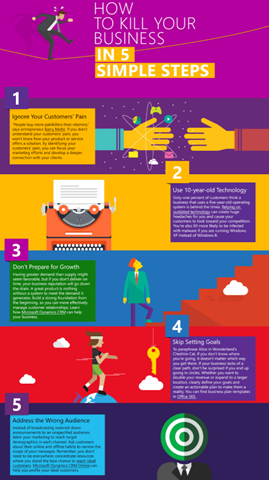
How To Kill Your Business In 5 Simple Steps – By Microsoft

This infographic was released by Microsoft over the past couple of days and I love it. It’s the same sort of tone that I use to talk down to XP and W2003 usage defenders – you know the ones, they shrug their shoulders and make excuses. I haven’t seen this graphic anywhere else on Microsoft, and it was released under the title of “SMB Mentor Project”; it appears to be aimed at resellers.

image