News for IT Pros from AzureCon

Microsoft announced a bunch of new stuff in the Azure world today for AzureCon. Here’s a summary of the stuff relevant to IT pros. Azure is growing still:

image

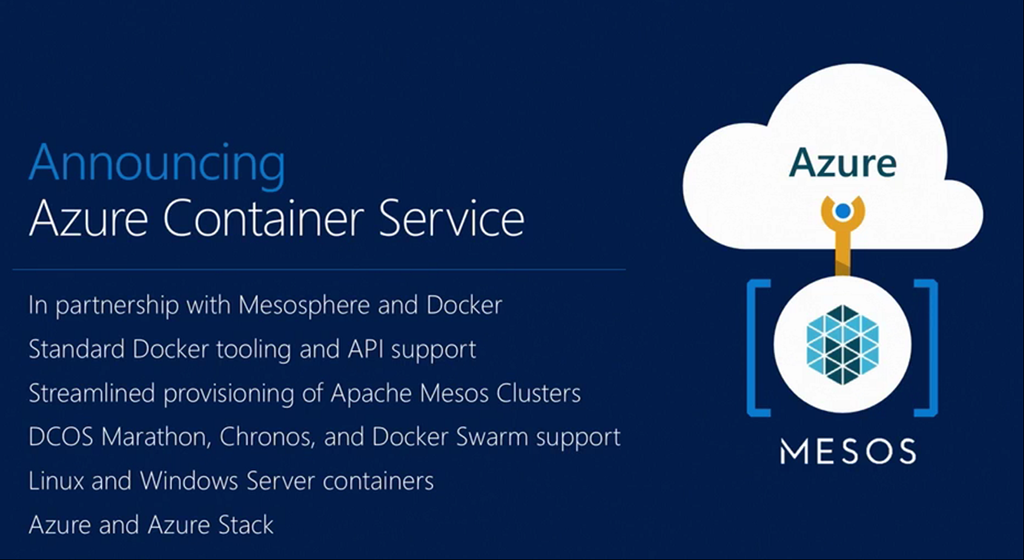
Azure Container Service

Microsoft describes this as:

… an open source container scheduling and orchestration service which builds on our partnerships with both Docker and Mesosphere, as well as our contributions to open source projects in this space.

This gives you Docker service delivery and Apache Mesos orchestrator. Other pieces included are Marathon for launching/scaling container-based application and Chronos, offering distribute cron job and batch workload management.

Azure Container Service will be in preview before the end of 2016.
image

Note that in the above slide (presented at AzureCon by Scott Guthrie) mentions the future on-premises Azure Stack.

More Regions

Three new regions just opened in India:

  • Central Indi (Pune)
  • South India (Chennai)
  • West India (Mumbai)

That should add about 60 new jobs to the Indian economy – it doesn’t take much labour to run one of these regions! Azure is available now, O365 will be there in October, and Dynamics CRM will come in H1 2016.

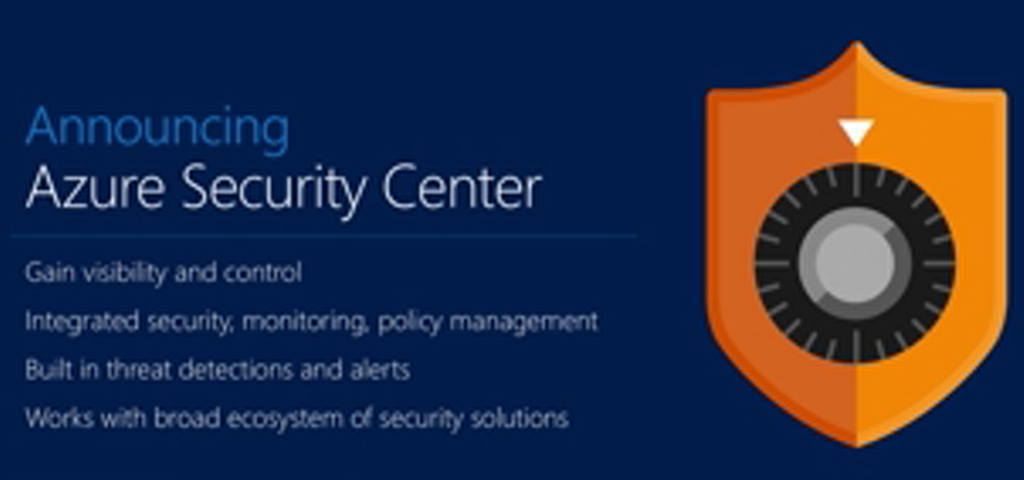
Azure Security Center

This is similar to something that was launched for O365 recently. Azure Security Center is:

… an integrated security solution that gives customers end to end visibility and control of the security of their Azure resources, helping them to stay ahead of threats as they evolve.

This solution integrates with partner solutions from the likes of Barracuda, Checkpoint, Cisco, CloudFlare, F5 Networks, Imperva, Incapsula, and Trend Micro.

You’ll get the usual monitoring and policy management, but ASC will also use information about global threats and your environment to make recommendations; that’s an interesting development! ASC will be broadly available by the end of 2016.
image

Guthrie said at AzureCon that there is DDOS detection built into this service.

image

Easier deployment of security appliances. And there’s best practices and scanning of network security groups (Extended Port ACLs in Azure). There is security alerting, that ingests data from the various partner vendors. Hadoop is analysing this data. SQL injection and DDOS attacks will appear in the alerts, maybe even pinpointing the location of those attacks.

This is a huge achievement of integrated advanced services.

N-Series VMs

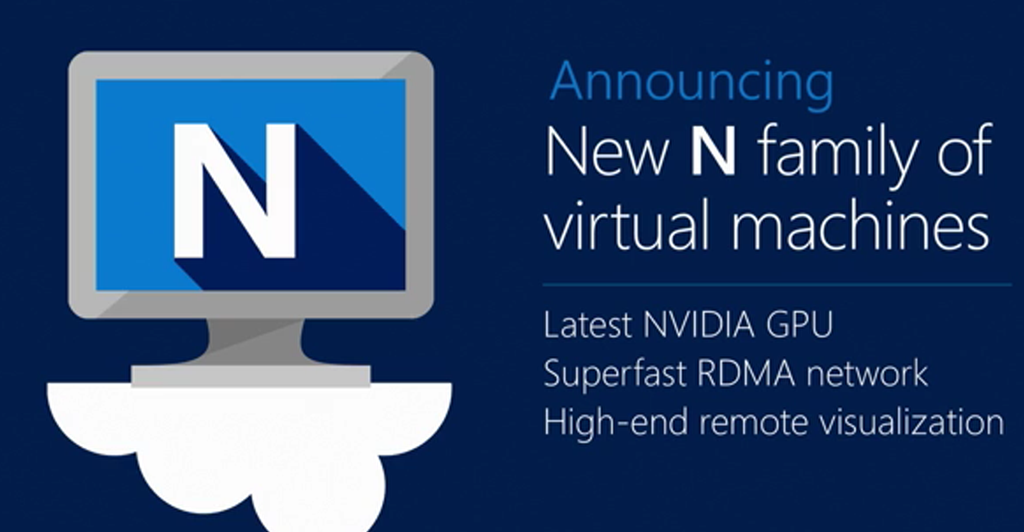
This had to come – N-Series VMs can be thought of as the NVIDIA VMs, because that’s exactly what they are, VMs with GPU capabilities. GPUs are great for graphic and compute intensive workloads. N-Series will be available in preview in the coming months, and will feature:

… NVIDIA Tesla Accelerated Computing Platform as well as NVIDIA GRID 2.0 technology, providing the highest-end graphics support available in the cloud today.
image

I think I heard Guthrie say that N-Series has Infiniband networking.

DV2 D-Series Virtual Machines

DV2 is D-Series Version 2 virtual machines. These VMs use a customized 2.4 GHz Intel Zeon E5 v3. With turbo boost 2.0 the clock can run up to 3.2 GHz, making it 32% faster than current D-series VMs.

Other News

Some bullets:

  • The general availability of ExpressRoute for O365 and Skype for Business, as well as the ability to connect to Microsoft Azure’s Government Cloud via ExpressRoute.
  • New pricing plans for ExpressRoute. Effective Oct 1st 2015, customers will have two different data plans for their ExpressRoute connections.
  • A8-A11 VM instances will be reduced in price by as much as 60%, starting Oct 1st. They needed this – it’s been much cheaper to run big workloads in traditional hosting or on-premises.
  • Azure File Storage is GA. Whoah – it’s based on SMB 3.0!
  • The general availability of Azure Backup of application workloads … Hmm, I’m reading this in-between the lines as the start of Project Venus, and “direct” might not be “direct”.  [EDIT] It was confirmed to me that this is Project Venus, and it is not live yet.
  • Upcoming availability of Azure Resource Health, a new service that exposes the health of each of Azure resources such as Virtual Machines, websites and SQL Databases to help customers quickly identify the root cause of a problem.

Lots of stuff there to keep the Azure bigwigs busy in their AzureCon keynotes.

Understanding Microsoft’s Explanation of Azure VM Specs

This post is a part of a series:

I have a great laugh when I am in front of a room and explaining Microsoft’s Azure VM specs to people. Take a look at this screenshot from the pricing site:

imageLet me ask you a few questions about the Basic A1 VM:

  1. How much disk space does that VM have?
  2. How many data disks can that VM be allocated?
  3. What is the max IOPS of each data disk?
  4. What are the maximum number of virtual NICs can that VM have?

Let me give you a clue:

  1. The answer is not 40 GB
  2. You don’t have enough information
  3. You don’t have enough information
  4. You don’t have enough information

We have answered 1/4 questions from the pricing site.

Let’s go dig for information on the Sizes For Virtual Machines page. Here we get a different set of information:

imageLet’s try answer those questions about the Basic A1 again:

  1. The answer is not 1063 (1023 + 40) GB
  2. A maximum of 2 data disks is correct
  3. Each data disk can have up to 300 IOPS. With 2 data disks, we can have an aggregate of 600 IOPS using Storage Spaces, etc, in the guest OS
  4. You still don’t have enough information.

OK, we now can answer 2/4 questions correctly! Let’s go to a reliable tool: Google. I found Create A VM With Multiple NICs. There I have found the below:

image

Now I can update my answers:

  1. The answer is not 1063 (1023 + 40) GB
  2. A maximum of 2 data disks is correct
  3. Each data disk can have up to 300 IOPS. With 2 data disks, we can have an aggregate of 600 IOPS using Storage Spaces, etc, in the guest OS
  4. A Basic A1 VM can have 1 virtual NIC

OK, would someone please tell me how much storage space will be consumed if I deploy a Basic A1 VM with Windows Server?!?!?!?!

The answer is that the C: drive of any Windows Server VM that is deployed from the Marketplace is 127 GB. The D: drive (a temporary drive that you should not store persistent data on) is indicated in the pricing. So, the Basic A1 VM will deploy a 127 GB C: drive and a 40 GB D: drive.

    1. How much disk space does that VM have? 167 GB.
    2. How many data disks can that VM be allocated? 1 maximum of 2.
    3. What is the max IOPS of each data disk? 300 IOPS.
    4. What are the maximum number of virtual NICs can that VM have? It can have 1 vNIC.

[EDIT]

I found another nugget of information today while pricing up DS-Series and GS-Series virtual machines. Microsoft says that DS-Series cost the same as D-Series. That’s no longer the case; D-Series was reduced in price on Oct 1st 2015, and DV2-Series was introduced as an upgrade. Now DS-Series costs the same as Dv2-Series at this time. GS-Series is still (at this time) the same price as G-Series.

If only there was a website with that information!

Microsoft News – 28 September 2015

Wow, the year is flying by fast. There’s a bunch of stuff to read here. Microsoft has stepped up the amount of information being released on WS2016 Hyper-V (and related) features. EMS is growing in terms of features and functionality. And Azure IaaS continues to release lots of new features.

Hyper-V

Windows Client

Azure

System Center

Office 365

EMS

Security

Miscellaneous

Configuring Windows Server Containers To Use DHCP Instead Of NAT

Read on if you want to learn how to connect Windows Server containers to an external virtual switch so that you don’t use NAT, and the containers actually talk directly to the LAN via DHCP assigned addresses. You’ll also see why a DHCP enabled container fails to get and address and ends up with a 169.254.x.x APIPA IPv4 configuration.

If you use Microsoft’s setup scripts for Windows Server 2016 (WS2016) Technical Preview 3 (TPv3), the default configuration for container networking is that each VM host will have virtual switch (in the VM), connected the VM’s vNIC. The virtual switch works in NAT mode, and uses a private network range to dynamically address containers that connect to the virtual switch. This set up requires each container to have NAT rules on the VM host so that external clients can connect to the services running in the containers. That … could be messy. In some terms, it could allow for huge network scalability (with tens of thousands of possible ports per VM host) but in others, it could be a nightmare to orchestrate.

What if you wanted your containers to talk directly on the LAN. In other words: no NAT. Yes, your containers can do this, and it’s known as a DHCP configuration – your containers are stateless so it’s pointless assigning them static IP addresses; instead the containers will get their addressing from DHCP services on the LAN.

Remember that there are two scripts that we can run to set up a VM host.

  • Method 1: You download New-ContainerHost.ps1 and run it. This downloads a bunch of stuff, creates a VM host, and then runs Install-ContainerHost.ps1. By default, this will configure the VM host with NAT networking.
  • Method 2: You create your own VM, download and run Install-ContainerHost.ps1. By default, you’ll get NAT networking.

But …

Install-ContainerHost.ps1 includes the option for a flag:

image

If you use method 2 then you could run Install-ContainerHost in the new VM host with the -UseDHCP flag set to $true; the behaviour of the script will change. By default it creates the VM host’s virtual switch in NAT mode. But enabling this flag creates an external virtual switch.

In my lab, I like to create my VM hosts using New-ContainerHost because it’s very quick (thanks to the use of differencing disks) and automates the entire setup. But New-ContainerHost doesn’t include the option for UseDHCP. You could edit any call of Install-ContainerHost from New-ContainerHost, but I do it another way.

Instead I edit Install-ContainerHost. One small change will do the trick. Not far from the top is where the parameters are set as script variables. Look for a line that reads:

$UseDHCP,

Modify this line so it reads:

$UseDHCP = $true,

image

Now every time I either run Install-ContainerHost or New-ContainerHost I’ll get the DHCP networking configuration instead of NATing.

So try this to create/configure a VM host, create a container, use Enter-PSSession to connect to the container, run IPConfig and … viola, you’ll have no DHCP address. Say what?

I was stumped. I tried it again. Nothing. I asked for help and by the time I got home, I got a tip from one of the folks in Redmond. It proved to be my “I’m a moron” moment of the day. If I’d thought about it, DHCP is all about broadcasts and MAC addresses. I have a single VLAN set up in the lab so broadcasts wasn’t the issue. What’s going on with MACs? A VM host has a MAC for itself. And then each container on the VM host that connects to the virtual switch has it’s own MAC address … but the network sees only one interface. Have you figured it out yet?

By default, Hyper-V has MAC spoofing disabled on every virtual NIC – a virtual NIC can only have 1 MAC address. What I needed to do was, at the host level, run the following to enable MAC spoofing on the VM host’s virtual NIC:

Get-VMNetworkAdapter -VMName containers3 | Set-vmNetworkAdapter -MacAddressSpoofing On

Now everything works Smile

Windows Server Containers – “Enter-PSSession : The term ‘Measure-Object’ Is Not Recognized”

If you’ve been working with Windows Server Containers in Windows Server 2016 (WS2016) Technical Preview 3 (TPv3) then you’ve probably experienced something like this:

  1. You create a new container
  2. Then start the container
  3. And try to create a PowerShell session into the container using Enter-PSSession

And then there’s lots of red on the screen:

enter-pssession : The term ‘Measure-Object’ is not recognized as the name of a cmdlet, function, script file, or
operable program. Check the spelling of the name, or if a path was included, verify that the path is correct and try
again.
At line:1 char:1
+ enter-pssession -ContainerId $container.ContainerId
+ ~~~~~~~~~~~~~~~~~~~~~~~~~~~~~~~~~~~~~~~~~~~~~~~~~~~
+ CategoryInfo          : ObjectNotFound: (Measure-Object:String) [Enter-PSSession], CommandNotFoundException
+ FullyQualifiedErrorId : CommandNotFoundException

image

Strangely, I have not been able to recreate this with Invoke-Command, so it appears to be unique to how Enter-PSSession sets up session in the container.

So how do you solve the issue? It’s simple – you rushed from starting your container to trying to log into it. Wait a few seconds and then try again.

Logging Into Windows Server Containers

How do you log into a container to install software? Ah … you don’t actually log into a container because a container is not a virtual machine. Confusing? Slightly!

What you actually do is remotely execute commands inside of a container; this is actually something like PowerShell Direct, a new feature in Windows Server 2016 (WS2016).

There are two ways to run commands inside of a container.

Which Container?

In Technical Preview 3 (TPv3), the methods we will use to execute commands inside of a container don’t use the name of the container; instead they use a unique container ID. This is because containers can have duplicate names – I really don’t like that!

So, if you want to know which container you’re targeting then do something along the lines of the following to store the container ID. The first creates a new container and stores the resulting container’s metadata in a variable object called $container.

$Container = New-Container -Name TestContainer -ContainerImageName WindowsServerCore

Note that I didn’t connect this container to a virtual switch!

The following example retrieves a container, assuming that it has a unique name.

$Container = Get-Container TestContainer

Invoke-Command

If you want to fire a single command into a container then Invoke-Command is the cmdlet to use. This method sends a single instruction into a virtual machine. This can be a command or a script block. Here’s a script block example:

Invoke-Command -ContainerID $Container.ContainerId -RunAsAdministrator -ScriptBlock { New-Item -Path C:\RemoteTest -ItemType Directory }

Note how I’m using the ContainerID attribute of $Container to identify the container.

The nice thing about Invoke-Command is that it is not interactive; the command remotely runs the script block without an interactive login. That makes Invoke-Command perfect for scripting; you write a script that deploys a container, starts it, does some stuff inside of the container, and then configures networking in the VM host. Lots of nice automation, there!

Enter-PSSession

If you want an interactive session with a container then Enter-PSSession is the way to go. Using this cmdlet you get a PowerShell session in the container where you can run commands and see the results. This is great for once-off stuff and troubleshooting, but it’s no good for automation/scripting.

Enter-PSSession -ContainerID $Container.ContainerId –RunAsAdministrator

Warning – In TPv3 we’ve seen that rushing into running this cmdlet after creating your new container can lead to an error. Wait a few seconds before trying to connect to the VM.

No Network Required!

These methods are using something PowerShell Direct, a new feature in WS2016 – it’s actually PowerShell via a named pipe. The above example deliberately created a VM that has no networking. I can still run commands inside of the container or get an interactive PowerShell session inside of the container without connectivity – I just need to be able to get onto the VM host.

Creating & Deploying Windows Server Containers Using NAT and PowerShell

This post will show you how to use PowerShell to deploy Windows Server Containers using Windows Server 2016 (WS2016) Technical Preview 3 (TPv3).

Note: I wanted to show you how to deploy IIS, but I found that IIS would only work on my first container, and fail on the others.

This example will deploy multiple containers running nginx web server on the same VM host. NAT will be used to network the VMs using a private IP range on the VM host’s internal virtual switch.

Note: The VM host is created at this point, with a working NATing virtual switch that has an IP range of 192.168.250.0/24, with 192.168.250.1 assigned to the VM host.

Create the nginx Container Image

The beauty of containers is that you create a set of reusable container images that have a parent child relationship. The images are stored in a flat file repository.

Note: In TPv3, the repository is local on the VM host. Microsoft will add a shared repository feature in later releases of WS2016.

Log into the VM host (which runs Server Core) and launch PowerShell

PowerShell

In this example I will create a new container using the default WindowsServerCore container OS image. Note that I capture the instance of the new container in $Container; this allows me to easily reference the container and it’s attributes in later cmdlets:

$Container = New-Container -Name nginx -ContainerImageName WindowsServerCore -SwitchName "Virtual Switch"

The container is linked to the virtual switch in the VM host called “Virtual Switch”. This virtual switch is associated with the VM’s sole virtual NIC, and sharing is enabled to allow the VM to also have network connectivity. The switch is enabled for NATing, meaning that containers that connect to the switch will have an IP of 192.168.250.x (in my setup). More on this stuff later.

Start the new container:

Start-Container $Container

Wait 30 seconds for the container to boot up and then remote into it:

Enter-PSSession -ContainerId $Container.ContainerId -RunAsAdministrator

I would normally use IIS here, but I had trouble with IIS in Windows Server Containers (TPv3). So instead, I’m going to deploy nginx web server. Run the following to download the installer (zip file):

WGet -Uri 'http://nginx.org/download/nginx-1.9.3.zip' -OutFile "c:\nginx-1.9.3.zip"

The next command will expand the zip file to  c:\nginx-1.9.3\

Expand-Archive -Path C:\nginx-1.9.3.zip -DestinationPath c:\ -Force

There isn’t really an installer. nginx exists as an executable that can be run, which you’ll see later. The service “install” is done, so now we’ll exit from the remote session:

Exit

We now have a golden container that we want to capture. To do this, we must first shut down the container:

Stop-Container $Container

Now we create a new reusable container image called nginx:

New-ContainerImage -Container $Container -Publisher AFinn -Name nginx -Version 1.0

The process only captures the differences between the original container (created from the WindowsServerCore container OS image) and where the machine is now. The new container image will be linked to the image that created the container. So, if I create a container image called nginx, it will have a parent of WindowsServerCore.

image

I’m done with the nginx container so I’ll remove it:

Remove-Container $Container –Force

Deploying A Service Using A Container

The beauty of containers is how quick it is to deploy a new service. We can deploy a new nginx web server by simply deploying a new container from the nginx container image. All dependencies, WindowsServerCore in this case, will also be automatically deployed in the container.

Actually, “deploy” is the wrong word. In fact, a link is created to the images in the repository. Changes are saved with the container. So, if I was to add content to a new nginx container, the container will contain the web content, and use the service and OS data from the nginx container image in the repository, and OS stuff from the VM host and the container OS image in the repository.

Let’s deploy a a new container with nginx. Once again I will store the resulting object in a variable for later use:

$Web2 = New-Container -Name Web2 -ContainerImageName nginx -SwitchName "Virtual Switch"

Then we start the container:

Start-Container $Web2

Wait 30 seconds before you attempt to remote into the container:

Enter-PSSession -ContainerId $Web2.ContainerId –RunAsAdministrator

Now I browse into the extracted nginx folder:

cd c:\nginx-1.9.3\

And then I start up the web service:

start nginx

Yes, I could have figured out how to autostart ngnix in the original template container. Let’s move on …

I want to confirm that nginx is running, so I check what ports are listening using:

NetStat –AN

I then retrieve the IP of the container:

IPConfig

Remember that the container lives in the NAT network of the virtual switch. In my lab, the LAN is 172.16.0.0/16. My VM host has 192.168.250.0/24 configured (Install-ContainerHost.ps1) as the NAT range. In this case, the new container, Web2 has an IP of 192.168.250.2.

I then exit the remote session:

Exit

There’s two steps left to allow HTTP traffic to the web service in the container. First, we need to create a NAT rule. The container will communicate on the LAN via the IP of the VM host. We need to create a rule that says that any TCP traffic on a select port (TCP 82 here) will be forwarded to TCP 80 of the container (192.168.250.2). Run this on the VM host:

Add-NetNatStaticMapping -NatName "ContainerNat" -Protocol TCP -ExternalIPAddress 0.0.0.0 -InternalIPAddress 192.168.250.2 -InternalPort 80 -ExternalPort 82

Finally, I need to create a firewall rule in the VM host to allow inbound TCP 82 traffic:

New-NetFirewallRule -Name "TCP82" -DisplayName "HTTP on TCP/82" -Protocol tcp -LocalPort 82 -Action Allow -Enabled True

Now if I open up a browser on the LAN, I should be able to browse to the web service in the container. My VM host has an IP of 172.16.250.27 so I browse to http://172.16.250.27:82/ and the default nginx page appears.

Deploy More of the Service

OK, we got one web server up. The beauty of containers is that you can quickly deploy lots of identical services. Let’s do that again. The next snippet of code will deploy an additional nginx container, start it, wait 30 seconds, and then log into it via session remoting:

$Web3 = New-Container -Name Web3 -ContainerImageName nginx -SwitchName "Virtual Switch"

Start-Container $Web3

Sleep 30

Enter-PSSession -ContainerId $Web3.ContainerId -RunAsAdministrator

I then start nginx, verify that it’s running, and get the NAT IP of the container (192.168.250.3).

cd c:\nginx-1.9.3\

start nginx

NetStat -AN

IPconfig

exit

Now I can create a NAT mapping for the container in the networking of the VM host. In this case we will forward traffic to TCP 83 to 192.168.250.4 (the container):

Add-NetNatStaticMapping -NatName "ContainerNat" -Protocol TCP -ExternalIPAddress 0.0.0.0 -InternalIPAddress 192.168.250.3 -InternalPort 80 -ExternalPort 83

And then we open up a firewall rule on the VM host to allow inbound traffic on TCP 83:

New-NetFirewallRule -Name "TCP83" -DisplayName "HTTP on TCP/83" -Protocol tcp -LocalPort 83 -Action Allow -Enabled True

Now I can browse to identical but independent nginx web services on container 1 on http://172.16.250.27:82/ and http://172.16.250.27:83/, all accomplished with very little work and a tiny footprint. One might be production. One might be test. I could fire up another for development. And there’s nothing stopping me firing up more to troubleshoot, branch code, and test upgrades, and more, getting a quick and identical deployment every time that I can dump in seconds:

Remove-Container $Web2, $Web3

If you have apps that are suitable (stateless and no AD requirement) then containers could be very cool.

“Install-WindowsFeature : An unexpected error has occurred” Error When You Run Install-WindowsFeature In A Windows Server Container

This is one of those issues that makes me question a lot of step-by-step blog posts on Windows Server Containers that are out there – plenty of people were quick to publish guides on containers and didn’t mention encountering this issue which I always encounter; I suspect that there’s a lot of copy/pasting from Microsoft sites with little actual testing in a rush to be first to publish. It’s clear that many bloggers didn’t try to install things in a container that required administrator rights, because UAC was blocking those actions. In my case, it was installing IIS in a Windows Server 2016 (WS2016) Technical Preview 3 (TPv3) container.

In my lab, I created a new container and then logged in using the following (I had already populated $Container by  returning the container object into the variable):

Enter-PSSession -ContainerId $Container.ContainerId -RunAsAdministrator

And then I tried to install some role/feature, such as IIS using Install-WindowsFeature:

Install-WindowsFeature -Name Web-Server

I logged in using -RunAsAdministrator so I should have no issues with UAC, right? Wrong! Because the installation fails as follows:

Install-WindowsFeature : An unexpected error has occurred. The system cannot find the file specified.  Error: 0x80070002
+ CategoryInfo          : InvalidResult: (@{Vhd=; Credent…Name=localhost}:PSObject) [Install-WindowsFeature], Exception
+ FullyQualifiedErrorId : RegistryKey_OpenSubKey_Failed,Microsoft.Windows.ServerManager.Commands.AddWindowsFeatureCommand

image

What’s the solution? When you are remoted into the container you need to raise your administrator privileges to counter UAC. You can do this as follows, after you log into the container:

Start-Process Powershell.exe -Verb runAs

Run Install-WindowsFeature now and it will complete.

image

Sorted!

Note: I have found in my testing that IIS behaves poorly in TPv3. This might be why Microsoft’s getting started guides on MSDN use nginx web server instead of IIS! I’ve confirmed that nginx works perfectly well.

Why Are My Windows Server Containers Not On The Network?

I find containers are easy to create and it’s pretty simple to build a library of container images. At least, that’s what I found when I got to play with containers for the first time on a pre-build Windows Server 2016 (WS2016) Technical Preview 3 (TPv3) lab. But I started playing with containers for the first time in my own lab in the last few days and I had some issues; the thing I had never done was create a host, a VM host to be precise (a Hyper-V VM that will host many containers), by myself. In this post I’ll explain how, by default, my containers were not networked and how I fixed it. This post was written for the TPv3 release, and Microsoft might fix things in later releases, but you might find some troubleshooting info that might be of help here.

Some Theory

I guess that most people will deploy Windows Server containers in virtual machines. If you work in the Hyper-V world then you’ll use Hyper-V VMs. In this timeframe the documented process for creating a VM host is to download and run a script called New-ContainerHost.PS1. You can get that by running:

wget -uri https://aka.ms/newcontainerhost -OutFile New-ContainerHost.ps1

You’ll get a script that you download and then you’re told by Microsoft and every other blog that copied & pasted without testing to run:

.\New-ContainerHost.ps1 –VmName <NewContainerHostVMName> -Password <NewContainerHostVMPassword>

What happens then?

  • A bunch of stuff is downloaded in a compressed file, including a 12 GB VHD called WindowsServer_en-us_TP3_Container_VHD.vhd.
  • The VHD is mounted and some files are dropped into it, including Install-ContainerHost.ps1
  • A new VM is created. The C: drive is a differencing VHD that uses the downloaded VHD as the parent
  • The VM is booted.
  • When the VM is running, Install-ContainerHost is run, and the environment is created in the VM.
  • Part of this is the creation of a virtual switch inside the VM. Here’s where things can go wrong by default.
  • The script completes and it’s time to get going.

What’s the VM switch inside a VM all about? It’s not just your regular old VM switch. It’s a NATing switch. The idea here is that containers that will run inside of the VM will operate on a private address space. The containers connect to the VM switch which provides the NATing functionality. The VM switch is connected to the vNIC in the VM. The guest OS of the VM is connected to the network via a regular old switch sharing process (a management OS vNIC in the guest OS).

What Goes Wrong?

Let’s assume that you have read some blogs that were published very quickly on the topic of containers and you’ve copied and pasted the setup of a new VM host. I tried that. Let’s see what happened … there were two issues that left me with network-disconnected containers:

Disconnected VM NIC

Almost every example I saw of New-ContainerHost fails to include 1 necessary step: specify the name of a virtual switch on the host to connect the VM to. You can do this after the fact, but I prefer to connect the VM straight away. This cmdlet adds a flag to specify which host to connect the VM to. I’ve also added a cmdlet to skip the installation of Docker.

.\New-ContainerHost.ps1 –VmName <newVMName> –Password <NewVMPassword> -SkipDocker –SwitchName <PhysicalHostSwitch>

This issue is easy enough to diagnose – your VM’s guest OS can’t get a DHCP address so you connect the VM’s vNIC to the host’s virtual switch.

New-NetNat Fails

This is the sticky issue because it deals with new stuff. New-NetNat will create:

… a Network Address Translation (NAT) object that translates an internal network address to an external network address. NAT modifies IP address and port information in packet headers.

Fab! Except it kept failing in my lab with this error:

Net-NetNat : No Matching interface was found for prefix (null).

image

This wrecked my head. I was about to give up on Containers when it hit me. I’d already tried building my own VM and I had downloaded and ran a script called Install-ContainerHost in a VM to enable Containers. I logged into my VM and there I found Install-ContainerHost on the root of C:. I copied it from the VM (running Server Core) to another machine with a UI and I edited it using ISE. I searched for 172.16.0.0 and found a bunch of stuff for parameters. A variable called $NATSubnetPrefix was set to “172.16.0.0/12”.

There was the issue. My lab’s network address is 172.16.0.0/16; this wasn’t going to work. I needed a different range to use behind the NATing virtual switch in the container VM host. I edited the variable to define a network address for NATing of “192.168.250.0/24”:

image


I removed the VM switch and then re-ran Install-ContainerHost in the VM. The script ran perfectly. Let’s say the VM had an address of 172.16.250.40. I logged in and created a new container (the container OS image is on the C:). I used Enter-PSRemote to log into the container and I saw the container had an IP of 192.168.250.2. This was NATed via the virtual switch in the VM, which in turn is connected to the top-of-rack switch via the physical host’s virtual switch.

Sorted. At least, that was the fix for a broken new container VM host. How do I solve this long term?

I can tell you that mounting the downloaded WindowsServer_en-us_TP3_Container_VHD.vhd and editing New-ContainerHost there won’t work. Microsoft appears to download it every time into the differencing disk.

The solution is to get a copy of Install-ContainerHost.PS1 (from the VHD) and save it onto your host or an accessible network location. Then you run New-ContainerHost with the –ScriptPath to specify your own copy of Install-ContainerHost. Here’s an example where I saved my edited (the new NAT network address) copy of Install-ContainerHost on CSV1:

.\New-ContainerHost.ps1 –VmName NewContainerVM –Password P@ssw0rd -SkipDocker -SwitchName SetSwitch -ScriptPath "C:\ClusterStorage\CSV1\Install-ContainerHost.ps1"

That runs perfectly, and no hacks are required to get containers to talk on the network. I then successfully deployed IIS in a container, enabled a NATing rule, and verified that the new site was accessible on the LAN.

Speaking At Experts Live 2015 in The Netherlands

An awesome looking event called Experts Live 2015 will be running in The Netherlands (CineMex, Ede), covering many aspects of Microsoft infrastructure solutions:

  • Azure
  • Office 365
  • OMS (and more Azure)
  • Azure Stack and Windows Azure Pack
  • Hyper-V
  • Windows

I’ll be speaking as a part of the Hyper-V track:

  • Less known Hyper-V best practices: Mike Resseler, MVP
  • SMB Direct – The Secret Decoder Ring: Didier Van Hoyw, MVP
  • Notes from your Program Manager: Jeff Woolsey, Microsoft/Redmond
  • What’s New in Hyper-V 2016: Aidan Finn (Me!), MVP
  • Storage Spaces Direct and Hyper-V – The Perfect Couple?: Carsten Rachfahl, MVP
  • Would you like Nano Server with Containers?: Thomas Maurer, MVP

In other words, it’s a whole bunch of Hyper-V MVPs from around Europe plus one of the senior Windows Server PMs from Redmond; that’s quite a cast of characters! I would register if I wasn’t one of the speakers.

I had a great time the last time I presented at a Dutch community event during the lead-up to WS2012, so I’m really looking forward to this trip. Hopefully I’ll see you there!