Clarifying Some Of Yesterday’s Azure Announcements

Yesterday, Microsoft marketing published a blog post where they said a lot of things about new services, features, and locations for Azure. Let’s just say that some content in the announcement was less … correct or clear than one might hope for. I’m not saying that this was deliberate, but there is a history of this in Microsoft – Mary Jo Foley and Paul Thurrott joke that this is why they have jobs!

Microsoft announced that 3 new regions went live in India yesterday. I tried a few times to create stuff in those regions, but none of the new regions appeared in my personal subscription (MSDN) or my work one (Open VL). I guessed that “ went live today” meant at some time during the day in the PDT time zone, so I decided to wait until the next morning (Irish time) but India was still not there. So I went looking.

image

So the India regions are live, but like the Australian and New Zealand regions, they are not available to me because I do not have a business presence in India (or Australia and New Zealand).

The announcement also said:

The general availability of Azure Backup of application workloads. Included as part of Microsoft Operations Management Suite, Azure Backup now supports direct backup of SQL Server, SharePoint, and Microsoft Dynamics.

There are three things that I could have read from that statement (please note that both of the following are incorrect):

  1. Azure Backup MARS agent now can backup applications without DPM and without Project Venus
  2. This service is live now
  3. Azure Backup only comes with OMS

I asked my contacts for some clarification. Project Venus is still happening and it is the only way that Azure Backup will be eventually able to directly backup applications. Project Venus is not GA yet, but will be soon – you can bet that I’ll blog about it! I’ve stung Marketing before over the hints that Azure Backup is only available in OMS – that is simply not true; yes, AB credit is included in the add-on, but the full AB service is available to anyone with an Azure subscription.

There might be more incorrect information in that announcement that I’m currently unaware of.

I wish these announcements were more clear and correct. If you’re honest and describe the plans with some sort of timeline then we’ll forgive things that aren’t perfect. But if we are lead on a wild goose chase, wasting time and money, to find contradicting facts buried elsewhere, then we think less of the company making the announcement.

News for IT Pros from AzureCon

Microsoft announced a bunch of new stuff in the Azure world today for AzureCon. Here’s a summary of the stuff relevant to IT pros. Azure is growing still:

image

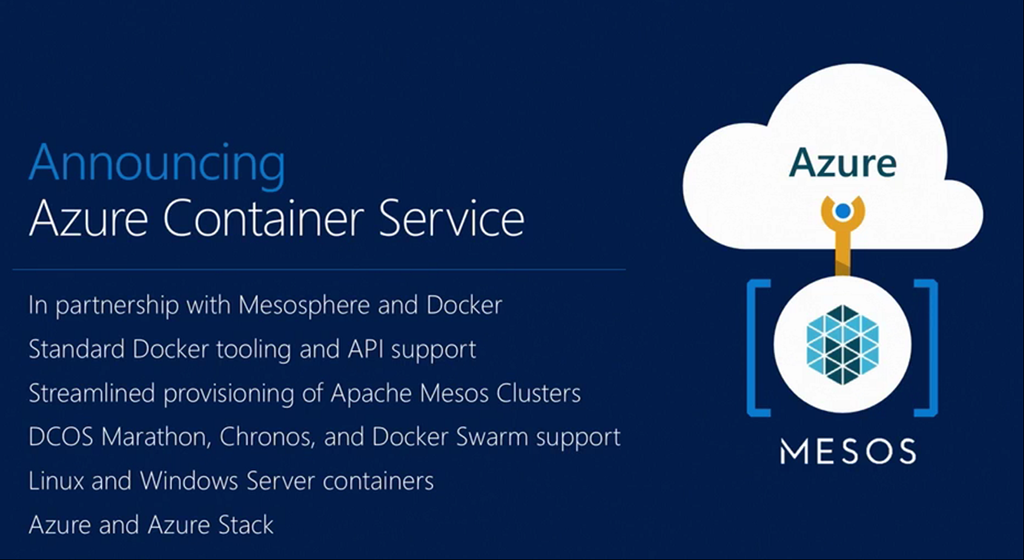
Azure Container Service

Microsoft describes this as:

… an open source container scheduling and orchestration service which builds on our partnerships with both Docker and Mesosphere, as well as our contributions to open source projects in this space.

This gives you Docker service delivery and Apache Mesos orchestrator. Other pieces included are Marathon for launching/scaling container-based application and Chronos, offering distribute cron job and batch workload management.

Azure Container Service will be in preview before the end of 2016.

image

Note that in the above slide (presented at AzureCon by Scott Guthrie) mentions the future on-premises Azure Stack.

More Regions

Three new regions just opened in India:

  • Central Indi (Pune)
  • South India (Chennai)
  • West India (Mumbai)

That should add about 60 new jobs to the Indian economy – it doesn’t take much labour to run one of these regions! Azure is available now, O365 will be there in October, and Dynamics CRM will come in H1 2016.

Azure Security Center

This is similar to something that was launched for O365 recently. Azure Security Center is:

… an integrated security solution that gives customers end to end visibility and control of the security of their Azure resources, helping them to stay ahead of threats as they evolve.

This solution integrates with partner solutions from the likes of Barracuda, Checkpoint, Cisco, CloudFlare, F5 Networks, Imperva, Incapsula, and Trend Micro.

You’ll get the usual monitoring and policy management, but ASC will also use information about global threats and your environment to make recommendations; that’s an interesting development! ASC will be broadly available by the end of 2016.

image

Guthrie said at AzureCon that there is DDOS detection built into this service.

image

Easier deployment of security appliances. And there’s best practices and scanning of network security groups (Extended Port ACLs in Azure). There is security alerting, that ingests data from the various partner vendors. Hadoop is analysing this data. SQL injection and DDOS attacks will appear in the alerts, maybe even pinpointing the location of those attacks.

This is a huge achievement of integrated advanced services.

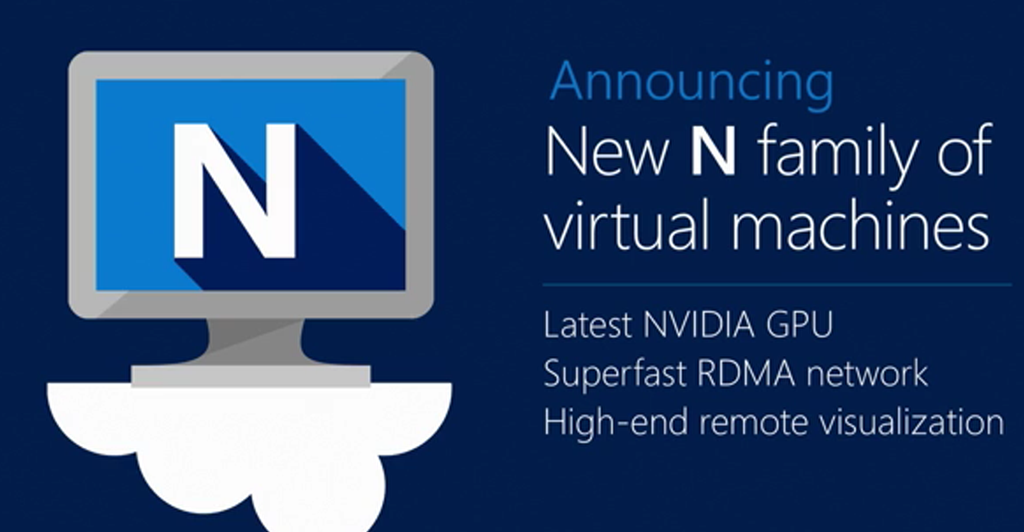
N-Series VMs

This had to come – N-Series VMs can be thought of as the NVIDIA VMs, because that’s exactly what they are, VMs with GPU capabilities. GPUs are great for graphic and compute intensive workloads. N-Series will be available in preview in the coming months, and will feature:

… NVIDIA Tesla Accelerated Computing Platform as well as NVIDIA GRID 2.0 technology, providing the highest-end graphics support available in the cloud today.

image

I think I heard Guthrie say that N-Series has Infiniband networking.

DV2 D-Series Virtual Machines

DV2 is D-Series Version 2 virtual machines. These VMs use a customized 2.4 GHz Intel Zeon E5 v3. With turbo boost 2.0 the clock can run up to 3.2 GHz, making it 32% faster than current D-series VMs.

Other News

Some bullets:

  • The general availability of ExpressRoute for O365 and Skype for Business, as well as the ability to connect to Microsoft Azure’s Government Cloud via ExpressRoute.
  • New pricing plans for ExpressRoute. Effective Oct 1st 2015, customers will have two different data plans for their ExpressRoute connections.
  • A8-A11 VM instances will be reduced in price by as much as 60%, starting Oct 1st. They needed this – it’s been much cheaper to run big workloads in traditional hosting or on-premises.
  • Azure File Storage is GA. Whoah – it’s based on SMB 3.0!
  • The general availability of Azure Backup of application workloads … Hmm, I’m reading this in-between the lines as the start of Project Venus, and “direct” might not be “direct”.  [EDIT] It was confirmed to me that this is Project Venus, and it is not live yet.
  • Upcoming availability of Azure Resource Health, a new service that exposes the health of each of Azure resources such as Virtual Machines, websites and SQL Databases to help customers quickly identify the root cause of a problem.

Lots of stuff there to keep the Azure bigwigs busy in their AzureCon keynotes.

Microsoft News – 28 September 2015

Wow, the year is flying by fast. There’s a bunch of stuff to read here. Microsoft has stepped up the amount of information being released on WS2016 Hyper-V (and related) features. EMS is growing in terms of features and functionality. And Azure IaaS continues to release lots of new features.

Hyper-V

Windows Client

Azure

System Center

Office 365

EMS

Security

Miscellaneous

Microsoft GAs The Last Vital Piece For VM Hosting

Microsoft announced that Azure Backup for Azure IaaS virtual machines (VMs) was released to generally availability yesterday. Personally, I think this removes a substantial roadblock from deploying VMs in Azure for most businesses (forget the legal stuff for a moment).

No Backup – Really?

I’ve mentioned many times that I once worked in the hosting business. My first job was as a senior engineer with what was then a large Irish-owned company. We ran three services:

  • Websites: for a few Euros a month, you could get a plan that allowed 10+ websites. We also offered SQL Server and MySQL databases.
  • Physical servers: Starting from a few hundred Euros, you got one or more physical servers
  • Virtual machines: I deployed the VMware (yeah, VMware) farm running on HP blades and EVA, and customers got their own VNET with one or more VMs

The official line on websites was that there was no backup of websites or databases. You lose it, you LOST it. In reality we retained 1 daily backup to cover our own butts. Physical servers were not backed up unless a customer paid extra for it, and they got an Ahsay agent and paid for storage used. The same went for VMware VMs – pay for the agent + storage and you could get a simple form of cloud backup.

Backup-less Azure

Until very recently there was no backup of Azure VMs. How could that be? This line says a lot about how Microsoft thinks:

Treat your servers like cattle, not pets

When Azure VMs originally launched in beta, the VMs were stateless, much like containers. If you rebooted the VM it reset itself. You were supposed to write your applications so that they used Azure storage accounts or Azure SQL databases. There was no DC or SQL Server VM in the cloud – that aws silly because no one deploys or uses stateful machines anymore. Therefore you shouldn’t care if a VM dies, gets corrupted, or is accidentally removed – you just deploy a new one and carry on.

Except …

Almost no one deploys servers like that.

I can envision some companies, like an Ebay or an Amazon running stateless application or web servers. But in my years of working in large and small/medium businesses, I’ve never seen stateless machines, and I’ve never encountered anyone with a need for those style of applications – the web server/database server configuration still dominates AFAIK.

So this is why Azure never had a backup service for VMs. A few years ago, Microsoft changed Azure VMs to be stateful (Hyper-V) virtual machines that we are familiar with and started to push this as a viable alternative to traditional machine deployments. I asked the question: what happens if I accidentally delete a VM – and I got the old answer:

Prepare your CV/résumé.

Mark Minasi quoted me at TechEd North America in one of his cloud Q&A’s with Mark Russinovich 2 years ago – actually he messed up the question a little and Russinovich gave a non-answer. The point was: how could I possibly deploy a critical VM into Azure if I could not back it up.

Use DPM!

Yeah, Microsoft last year blogged that customers should use System Center Data Protection Manager to protect VMs in Azure. You’d install an agent into the guest OS (you have no access to Azure hosts and there is no backup API) and backup files, folders, databases to DPM running in another VM. The only problem with this would be the cost:

  • You’d need to deploy an Azure VM for DPM.
  • You would have to use Page Blobs & Disks instead of Block Blobs, doubling the cost of Azure storage required.
  • The cost of System Center SMLs would have been horrific. A Datacenter SML ($3,607 on Open NL) would cover up to 8 Azure virtual machines.

Not to mention that you could not simply restore a VM:

  • Create a new VM
  • Install applications, e.g. SQL Server
  • Install the DPM agent
  • Restore files/folders/databases
  • Pray to your god and any others you can think of

Azure Backup

Azure has a backup service called Azure Backup. This was launched as a hybrid cloud service, enabling you to backup machines (PCs, servers) to the cloud using an agent (MARS). You can also install the MARS agent onto an on-premises DPM server to forward all/subset of your backup data to the cloud for off-site storage. Azure Backup uses Block Blob storage (LRS or GRS) so it’s really affordable.

Earlier this year, Microsoft launched a preview of Azure Backup for Azure IaaS VMs. With this service you can protect Azure VMs (Windows or Linux) using a very simple VM backup mechanism:

  1. Create a backup policy – when to backup and how long to retain data
  2. Register VMs – installs an extension to consistently backup running VMs
  3. Protect VMs: Associate registered VMs with a policy
  4. Monitor backups

The preview wasn’t perfect. In the first week or so, registration was hit and miss. Backup of large VMs was quite slow too. But the restore process worked – this blog exists today only because I was able to restore the Azure VM that it runs on from an Azure backup – every other restore method I had for the MySQL database failed.

Generally Available

Microsoft made Azure Backup for IaaS VMs generally available yesterday. This means that now you can, in a supported, simple, and reliable manner, backup your Windows/Linux VMs that are running in Azure, and if you lose one, you can easily restore it from backup.

A number of improvements were included in the GA release:

  • A set of PowerShell based cmdlets have been released – update your Azure PowerShell module!
  • You can restore a VM with an Azure VM configuration of your choice to a storage account of your choice.
  • The time required to register a VM or back it up has been reduced.
  • Azure Backup is in all regions that support Azure VMs.
  • There is improved logging for auditing purposes.
  • Notification emails can be sent to administrators or an email address of your choosing.
  • Errors include troubleshooting information and links to documentation.
  • A default policy is included in every backup vault
  • You can create simple or complex retention policies (similar to hybrid cloud backup in MARS agent) that can keep data up to 99 years.

Summary

With this release, Microsoft now has solved my biggest concern with running production workloads in Azure VMs – now we can backup and restore stateful machines that have huge value to the business.

Technorati Tags: ,,

Microsoft News – 7 September 2015

Here’s the recent news from the last few weeks in the Microsoft IT Pro world:

Hyper-V

Windows Server

Windows

System Center

Azure

Office 365

Intune

Events

  • Meet AzureCon: A virtual event on Azure on September 29th, starting at 9am Pacific time, 5pm UK/Irish time.

Microsoft News 13-August-2015

Hi folks, it’s been a while since I’ve posted but there’s a great reason for that – I got married and was away on honeymoon 🙂 We’re back and trying to get back into the normal swing of things. I was away for the Windows 10 launch, happily ignoring the world. Windows 10 in the businesses is not a big deal yet – Microsoft needs to clear up licensing and activation for businesses before they’ll deliberately touch the great new OS – I’ve already had customers say “love it, but not until we get clarification”.

Hyper-V

Windows Server

Windows

Azure

System Center

Office 365

Miscellaneous

Microsoft Modifies The Azure Backup Announcement

Yesterday I posted an “Aidan Smash” article about the messed up Azure Backup Announcement. Microsoft had originally stated in their announcement of improvements that were coming to Azure Backup. Let’s remind ourselves what Microsoft said:

image_thumb[1] Why did I take a screenshot of the text instead of copying/pasting it? I’ve learned that when Microsoft makes a controversial announcement, or something that is just plain dumb, that text can change without any notice.

Controversy? Yes; Microsoft pretty much stated that the requests for feature improvements in Azure Backup that would make the product marketable to the breadth market (that will actually use Azure Backup) was going to be restricted to System Center customers that paid extra for OMS Add-On for Azure (not the breadth market).

That sounded pretty stupid. I reached out for a correction but did not get one within the 24 hours before I posted my rant. So it seemed that someone had made yet another dumb packing/pricing decision with a Microsoft online service.

24 hours later, the announcement was changed by Microsoft:

image

Note that the post does not say the following anymore:

… we are now announcing new Azure Backup services that are available today to OMS customers.

In fact, all mention of OMS in this section and the bullet points has been removed. Queue cautious celebration!

How do I read this (as a person that does not have access to OMS Add-On and cannot verify what OMS customers have access to)?

  • The new features will not be restricted to OMS Add-On customers
  • The new features are not available yet

This is much better. Now if only the author had bothered to communicate clearly in the first place – I’m guessing they were made walk the plank.

[Update]

Microsoft confirmed that the improvements to Azure Backup will be coming to everyone. These features will be coming before the end of the calendar year. I look forward to trying them out, and hopefully selling them.

An Open Letter To Scott Guthrie About Azure Backup

Oh baby, it’s one of those posts where Aidan Smash! I think Azure Backup has amazing potential to OWN the online backup market, but thanks to the leadership of that group, Azure Backup is irrelevant. Read on to find out why.

[Update]

Microsoft modified the below announcement and details were confirmed to me. Read here to learn more.

What’s Online Backup and What is the Market?

We all know what on-premises backup is:

  • Something like DPM, Veeam, Altaro, Commvault, ArcServe, etc runs a job to backup files, folders, system state, VMs, or whatever
  • Data is sent to a disk and/or tape archive
  • We restore data from there when it’s corrupted or lost

An old saying in IT goes: you don’t have a backup if you don’t have 3 copies. In IT we know that we should keep off-site copies of data. In the old days, Iron Mountain would pick up a bag of tapes and courier them off to some place. If we needed to go back more than a week, then we’d have to call those tapes in (cost + delay) and that sucked. Plus tapes are fragile.

Some folks implemented site-to-site replication of backup (DPM, Veeam, etc) to counter this. Data is sent off to another location so the data is available no matter what happens to the primary site. But … there’s a cost to keeping an archive.

This is where online backup is meant to come into play. A hosting company can offer huge amounts of cheap storage. An agent is deployed to required machines (roaming user devices, servers, hosts, VMs) and does an online backup. Data might be proxied/stored locally with a short retention period, and stored in the cloud with a long retention period. There’s lots of variations in the offerings so don’t get caught up in the details here.

The Challenge with Online Backup

It’s simple: Price. The dominant service in Ireland (based on reseller-friendly Ahsay) costs anywhere from €0.30 to €1.00 per GB stored per month. So when Microsoft came along with Azure and offered a cheaper alternative you’d think that they’d wipe the floor with the competition, right?

What’s Wrong with Azure Online Backup?

I break up AB into three offerings, to try clarify the mess that Azure Marketing/Branding has created:

  • Azure Backup for IaaS/VMs: Backs up VMs running in Azure to block blob storage
  • DPM + Azure Backup: DPM backs up Hyper-V, files/folders, SQL Server, SharePoint, Exchange, etc, and an AB agent on the DPM server forwards selected data to Azure block blob storage
  • Azure Backup: An agent (called MARS) is installed on each machine that will be backed up, and it can only support files and folders, only files and folders, and nothing but files and folders, and if you ask about anything other than files and folders then you are a complete moron that should walk onto the street and ask to be hit in the head with a baseball bat (it might improve your IQ)

The market for Azure Backup is not the large enterprise. It’s SMEs … as I said it was quite some time ago with Azure Site Recovery (the ASR team has since acknowledged that I was correct). When Azure first went on sale via Open licensing (SMEs) I talked to Microsoft partners about this. The price then was around €0.25 per GB, which then dropped to €0.149/GB and now sits at as little as €0.0.17/GB (approx – I’m too lazy to Google it) plus “instance” charge. So Azure Backup completely took over the Irish market, right? Uh, not so fast, my friend! Anyone selling the incumbent is still selling the incumbent, and that’s because the AB leadership continues to ignore overwhelming feedback. Instead, they focus on scenarios for System Center customers, and although “sales” of System Center to SMEs might be green on the scorecard, that’s because of some “clever tricks” that various news sites have alluded to and the occasional large customer that refuses to buy Select/EA. In the real world, SMEs do not use System Center, so focusing on System Center customers is ignoring the huge breadth market that currently uses online backup solutions that cost much more than AB.

Note: Any Redmond-ites that think SMEs are  just single-server companies are free to step off of their ivory tower and visit the real world outside of insulated and misinformed bubble.

What feature blockers are there to using AB?

  • Centralised management: There is no centralised management for AB. All management is done on a per-machine basis – which sucks. Customers hate this, and the resellers that are the IT department of those customers detest it because it’s unmanageable.
  • Backup support: Ab only does files and folders. Customers always ask about SQL Server, Exchange, Hyper-V and more. The Microsoft answer is: Use DPM. However, SMEs cannot afford DPM because it’s hidden in System Center licensing.
  • Pricing complexity: Have you met instances? Go on – google the pricing for Azure Backup and see what you think. We’ve actually lost Azure deals because of this BS that was introduced on April Fool’s Day.

We kept hearing that the AB team was going to fix all of this. And then yesterday, I read a post about Operations Management Suite (OMS) Add-On for System Center. There you will find this piece of text:

image


Here’s what you need to know first: The OMS Add-On can only be bought by System Center customers: 1 Std Add-On for 1 Std SML, 1 DC Add-On for 1 DC SML. And the new features of AB are only available to OMS Add-On customers:

  • Adding DPM technology to the AB agent: I don’t have OMS and I tested the latest agent that I can download. I still can only backup files and folders. It appears that this new agent for AB to solve the issue that AB can only backup files and folders, is only available to customers with DPM licensing. Some genius thought that to solve the lack of DPM, you need to buy DPM, to use a backup agent that isn’t DPM. Friggin’ Einstein, right? Give that person a job running the economy for Greece or Zimbabwe!
  • Centralised management: Only available to DPM customers, the sort that don’t do much online backup, while ignoring the breadth market that will and does backup to the cloud with more expensive alternative vendors that do offer what those customers need.

It’s quite clear that the AB group either doesn’t understand the feedback and/or refuses to listen.

A Request for Scott Guthrie

Scott, I know you’re a smart man. Why do you and how can you tolerate this continued failure? I know you could sell a lot more Azure storage if you opened up Azure Backup to the SME market with improved backup support and centralised management. I could probably have half of the Irish market switched over by now if someone in Microsoft was actually acting on the feedback that they’ve been getting since last summer. Ireland is a tiny market in the grand scheme of things, but the nature of our market is the same across the entire EU and I doubt the USA is much different. That’s a lot of money you’re leaving on the table for competition to take.

I know that someone in Microsoft (probably Dublin) will complain about “that loud MVP” again, and I’ll have the usual conversations. But I know I’m right and I’ve repeatedly given the feedback via forum, direct emails to relevant PMs, and Lync conversations. Give us the product we need, and we’ll sell the heck out of it to people that will use it. So, Scott, I’m imploring you to make the necessary changes. Stop focusing Azure Backup on System Center customers; it’s a waste of dev/test time. Focus on SMEs and resellers and you will take over the online backup market in a year with customers that are actually adopting or using Azure.

Microsoft News – 29 June 2015

As you might expect, there’s lots of Azure news. Surprisingly, there is still not much substantial content on Windows 10.

Hyper-V

Windows Server

Windows Client

clip_image001_thumb.png

Azure

Office 365

EMS

Misc

Living with & Paying for Azure VM Backup

This site is running on an Azure Basic A2 VM with 127 GB of storage. I back it up in two ways:

  • There is an Azure Backup (AB) agent installed in the guest OS, and that backs up an export of MySQL and the IIS content.
  • I use the (preview) feature that allows you to grab a daily backup of a VM. This is what I want to focus on.

I have deployed a GRS backup vault. The usage summary is:

image

The storage cost of the backup this month will be around €2.5776 (72 * €0.0358 per GB) and the instance cost will be €7.447 (The VM size falls into 50-500 GB).

There is a daily backup with 4 weeks of retention. Right now, there are 29 days of history:

image

Backup can be slow (ranges from 47 minutes to 4 hours and 13 minutes), but I haven’t had any issues.

image

I haven’t had to do a restore, but so far, so good.

Technorati Tags: ,,