Microsoft Killing Off The Classic Azure Management Portal

Microsoft has announced that they are killing off the classic Azure management portal (https://manage.windowsazure.com) on January 8th.

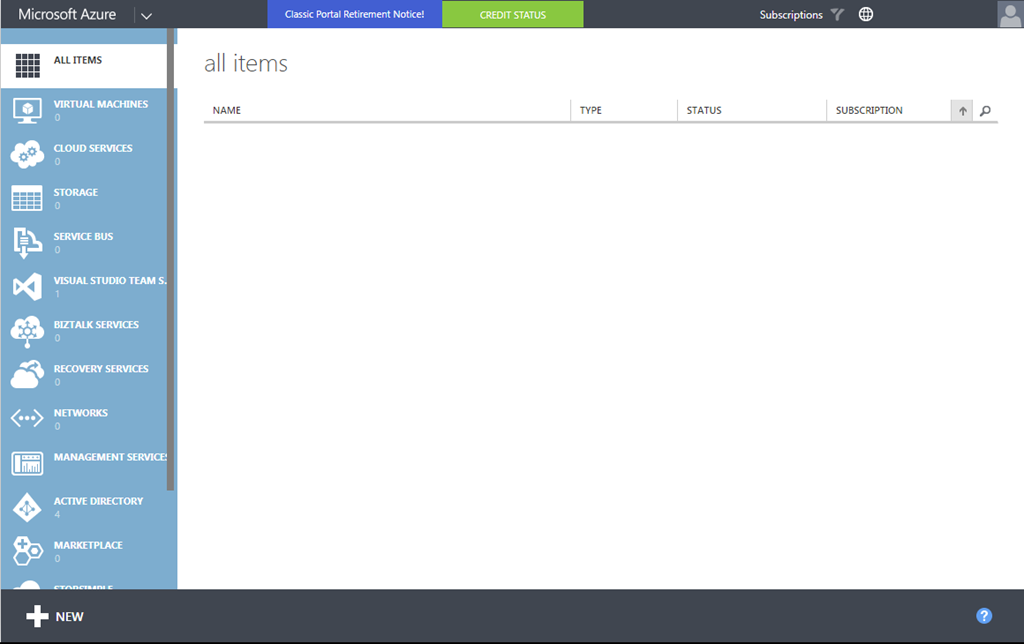
If you are using this portal, the old/classic Azure Management Portal …

image

… then it’s time to switch to this portal, the Azure Portal (https://portal.azure.com) …

image

This change should not come as a surprise. The Azure Portal has been around for several years (without checking, I think the preview started at the last TechEd North America, 4 years ago), and has been fully GA and functional for quite a while now. Also, it’s been years since new features were added to the classic Management Portal, whereas the Azure Portal is not only where new features are added, it’s also the admin interface for Azure, Azure AD, Azure Information Protection, Intune, and more. It’s also a lot easier to use and the only place where you can deploy & manage Resource Manager (ARM) resources.

In addition, Microsoft has been turning off parts of the old Management Portal over time. Storage accounts and Azure AD have been wound down (also at short notice), so the clock has been ticking for a while.

People who don’t read blogs, ignore tech news, and social media (most techies, to be frank) will see a notification, “Classic Portal Retirement Notice!” in the top of the classic portal, that they can expand:

image

So stop clinging to the past – join us where things are easier, there is more functionality, and there’s actually a future.

EDIT: Just to be clear, you do not need to do a classic-to-ARM migration to use the Azure Portal. The Azure Portal supports both classic and ARM resources. But I’d still recommend migrating from classic to ARM (MS already did this for you in PaaS) so you can avail of the features that Azure IaaS in ARM can offer.

Was This Post Useful?

If you found this information useful, then imagine what 2 days of training might mean to you. I’m delivering a 2-day course in Amsterdam on April 19-20, teaching newbies and experienced Azure admins about Azure Infrastructure. There’ll be lots of in-depth information, covering the foundations, best practices, troubleshooting, and advanced configurations. You can learn more here.

There Are 732 Hours In An Azure Month

Did you know that the average month in Azure is 732 hours long? And that when you ask an Azure pricing tool for a monthly cost, it takes the hourly cost and multiplies it by 732 … and that used to be 744!

Since I started working with Microsoft Azure, I’ve been using 744 hours as the average month in the Azure universe. That was because that’s what Microsoft used.

Only this week my colleague saw that Microsoft had switched to using 732 hours. I was puzzled so we checked, confirmed, and opened Excel to do some maths.

Let’s analyse 744 hours first:

744 (hours per month) * 12 months = 8928 hours per year.

8928 hours per year / 365 days = 24.46 hours.

Hmm. Let’s allow for a leap year:

8928 hours per year / 366 days = 24.39 hours.

OK. Let’s forget 744 hours and go with 732.

732 (hours per month) * 12 months = 8784 hours per year.

8784 hours per year / 365 days = 24.066 hours.

Not quite even. Let’s go with a leap year:

8784 hours per year / 365 days = 24 hours exactly.

Sooo ….

732 hours is the average length of a month in a leap year.

Azure’s monthly pricing is based on the average month in a leap year.

Was This Post Useful?

If you found this information useful, then imagine what 2 days of training might mean to you. I’m delivering a 2-day course in Amsterdam on April 19-20, teaching newbies and experienced Azure admins about Azure Infrastructure. There’ll be lots of in-depth information, covering the foundations, best practices, troubleshooting, and advanced configurations. You can learn more here.

Video – Understanding the Azure VM Series

This short video will show you how to quickly understand the Azure virtual machine (VM) series, how to pick one for a deployment, and how to select the right size. I show my technique for remembering what each SKU name means, so when you read it, you know exactly what that machine can do, and what the host offers.

Was This Video Useful?

If you found this information useful, then imagine what 2 days of training might mean to you. I’m delivering a 2-day course in Amsterdam on April 19-20, teaching newbies and experienced Azure admins about Azure Infrastructure. There’ll be lots of in-depth information, covering the foundations, best practices, troubleshooting, and advanced configurations. You can learn more here.

Video – What is Microsoft Azure?

I’ve posted a short video to help people understand what Microsoft Azure is, how it can impact a business, where it is, how Microsoft has made Azure compliance with lots of regulations and standards, and what Azure can do.


image

Was This Video Useful?

If you found this information useful, then imagine what 2 days of training might mean to you. I’m delivering a 2-day course in Amsterdam on April 19-20, teaching newbies and experienced Azure admins about Azure Infrastructure. There’ll be lots of in-depth information, covering the foundations, best practices, troubleshooting, and advanced configurations. You can learn more here.

New Virtual Machines Series in Azure Dublin / North Europe

I was helping troubleshoot something for a customer today when I noticed that some of the newer VM series have finally arrived in Azure’s Dublin / North Europe region:

  • D_v3: The successor to the D_v2 machines (including the “S” Premium Storage variants) that are designed for disk/database workloads. The machine is 28% cheaper than the RRP of the D_v2, but that’s because it offers VMs on hosts with Hyperthreading … which reduces CPU performance by 28%. Common workloads care more about affordable core counts than GHz, which is what the D_v3 offers.
  • E_v3: The memory-optimized versions (more memory) of the D_v2 are also here, with the same 28% price/GHz reduction.
  • NV: These are machines with direct (not virtualized) access to NVIDIA M60 chipsets on their hosts, specialized for desktop virtualization.
  • NC: You can run virtual machines that are designed for computational workloads (simulations, etc) with these machines, using non-virtualized access to NVIDIA Tesla K80 GPUs.

I’ve just upgraded this server (shutdown – resize  – restart) from a DS2_v2 to a DS2_v3.

FYI, if you are still using the D_v2 promo offer in North Europe, you had better start planning for upgrading to the D_v3 soon if you want to keep that low price. It’s just a matter of time now until Microsoft announces the end of the pre-D_v3 promotion on D_v2 machines, and the price of the D_v2 returns back to normal (28% higher than the promo).

Was This Post Useful?

If you found this information useful, then imagine what 2 days of training might mean to you. I’m delivering a 2-day course in Amsterdam on April 19-20, teaching newbies and experienced Azure admins about Azure Infrastructure. There’ll be lots of in-depth information, covering the foundations, best practices, troubleshooting, and advanced configurations. You can learn more here.

I Am Running My “Starting Azure Infrastructure” Course in London on Feb 22/23

I am delighted to announce the dates of the first delivery of my own bespoke Azure training in London, UK, on February 21st and 22nd. All the details can be found here.

In my day job, I have been teaching Irish Microsoft partners about Azure for the past three years, using training materials that I developed for my employer. I’m not usually one to brag, but we’ve been getting awesome reviews on that training and it has been critical to us developing a fast growing Azure market. I’ve tweeted about those training activities and many of my followers have asked about the possibility of bringing this training abroad.

So a new venture has started, with brand new training, called Cloud Mechanix. With this business, I am bringing brand-new Azure training to the UK and Europe.  This isn’t Microsoft official training – this is my real world, how-to, get-it-done training, written and presented by me. We are keeping the classes small – I have learned that this makes for a better environment for the attendees. And best of all – the cost is low. This isn’t £2,000 training. This isn’t even £1,000 training.

The first course is booked and will be running in London (quite central) on Feb 22-23. It’s a 2-day “Starting Azure Infrastructure” course that will get noobies to Azure ready to deploy solutions using Azure VMs. And experience has shown that my training also teaches a lot to those that think they already know Azure VMs. You can learn all about this course, the venue, dates, costs, and more here.

I’m excited by this because this is my business (with my wife as partner). I’ve had friends, such as Mark Minasi, telling me to do this for years. And today, I’m thrilled to make this happen. Hopefully some of you will be too and register for this training Smile

Azure Backup MARS Agent System State Support is GA

Microsoft announced last week that they made support for backing up system state using the MARS agent generally available.

System State backup was one of those “I must have this” features that I’ve been hearing about for 3+ years. Today it’s there – update your version of the MARS agent and you’ll have it.

With this added backup, you can protect metadata:

  • Active Directory: Backup your AD so you can do DC recoveries.
  • File Servers: It’s nice being bale to restore files & folders, but what about the shares?
  • IIS Web Servers: Protect that IIS Metabase.

Adding System State to your backup policy is easy; either start a new schedule (new MARS installations) or edit the existing schedule. System State will appear in the Add Items box. Select System State and complete the wizard. It’s easy … the way backup should be!

Was This Post Useful?

If you found this information useful, then imagine what 2 days of training might mean to you. I’m delivering a 2-day course in Amsterdam on April 19-20, teaching newbies and experienced Azure admins about Azure Infrastructure. There’ll be lots of in-depth information, covering the foundations, best practices, troubleshooting, and advanced configurations. You can learn more here.

Hit Refresh – A Book By MS CEO Satya Nadella

I recently purchased the hard back copy of Hit Refresh, the new book by Microsoft CEO Satya Nadella. I got it at MS Ignite, and read it on the plane between Orlando and Seattle, and Seattle and San Francisco (a week later).

The book is much like an episode of the TV show, Arrow, blending today with flashbacks of Nadella’s past, using his life story to explain his outlook on managing Microsoft’s future. The book is split into two, first explaining how Nadella got the role and his mission to change the culture of Microsoft, and then the last few chapters explain what Nadella sees as the future.

Most of the first few chapters explain Nadella’s childhood and entry into IT. He wasn’t the classic nerd; he wanted to be a cricket player – that’s like wanting to be a baseball player in the USA, but maybe bigger considering how popular cricket is in a huge country such as India. His father gave him the present of a computer, and like many with an early home computer (ZX-81, I think), he started programming in BASIC, and learned the power of code. Nadella discusses his journey to America, and to Microsoft. Of huge importance, is his personal life and how it formed his outlook on life. Microsoft’s renewed (and genuine) focus on accessibility and community involvement can be better understood by understanding the man.

Nadella’s mission with Microsoft was to change the culture. If you knew Microsoft employees from 5 years ago, they weren’t a happy bunch. Enron’s stack ranking system was used to review staff – someone in the team must always get the “stinker” review – and why would anyone copy anything from Enron, seriously!?!?! The company appeared to have no mission, petty fiefdom squabbling killed innovation, and Microsoft became a place where innovation was unacceptable. Microsoft had plans to get into mobile very early on, but they were killed off. Sinofsky was … you know already! Microsoft was always late to every party, and had become reliant on Office software & Windows sales, both of which were at huge risk. He knew all this, he’d seen things he disagreed with (acquisition of Nokia), and wanted a root change within the corporation.

Phrases like “growth mindset”, “culture change” and “empathy” are throughout the book. Every decision must help the corporation grow – for example, acquiring Minecraft wasn’t an obvious case of growth, but it’s been a marketing coup and has Microsoft products/services in the hands of most under-10s out there. Closing Nokia killed a cancer that was eating Microsoft. And most of all, Nadella did start a culture change. I’ve been dealing with Redmond and engineering teams for 10 years now. In 2010-2012, Microsoft was a bit of a black hole. In 2014, Microsoft was very different; instead of telling us what to think, we were being asked for our thoughts and opinions. I can look at WS2016 and point out things that I and other Windows Server MVPs gave feedback on, including one that MS didn’t think was necessary at all, which became a key feature! I’m regularly in contact with Azure program managers who are hungry for feedback.

Today’s Microsoft takes smart chances with Surface, creates HoloLens, forms alliances with old rivals (Salesforce, RedHat, Apple, Amazon, and more) where there are mutual opportunities that benefit both sets of customers. Microsoft has bent over so far backwards to embrace opensource in Azure that they are probably the most open-friendly public cloud around.

It wasn’t easy for Nadella to accomplish this. He goes into a lot of detail about how this was done. Some of his approaches were rebuffed a bit at first, he broke some traditions, but these are things that needed to be broken.

In the final chapters, he talks about the future of Microsoft. He’s clear that Microsoft completely missed the boat when it came to mobile devices. Microsoft was too late to market and there wasn’t room for a 3rd platform. He’s quite clear about that in interviews – what can Microsoft do that will be different and attractive enough to bring a critical mass of customers to a new product? Simple being another OS doesn’t cut it, and several years of 3 generations of Windows Phone/Mobile proved that. What Microsoft does bring is genius, and the power of the cloud. Microsoft’s big push for the future is based on IoT, AI, and quantum computing. The three solutions are intertwined and there is an indirect consumer link – a customer’s freezer can malfunction, a bot can reach out, and that bot’s AI could be trained/enhanced by quantum computing.

This book isn’t going to change your life. There’s no life & death car chases. No one barely escapes being eaten by a black hole. But if you are interested in the world of Microsoft, this might be an interesting read to understand the new Microsoft. A lot of the text is very Nadella-keynote, being repetitive, dry, and conceptual. But you will come away understanding his thought process, realizing how well read and educated the man his, how he thinks deep about everything, and most of all, why empathy is so important to him.

Two Weeks Of Learning Coming To An End

I’ve been on the road for the last 2 weeks. The first week I spent in Orlando at the Microsoft Ignite conference. The second week, I was one of 600 people to attend the “Intelligent Cloud Architect Boot Camp”, run by Microsoft in Bellevue, WA, in the US Pacific Northwest. It’s been tough to be away from my family for 2 straight weeks, not just on me, but more so on them, but we viewed it as an investment in our future.

I’ve made a career from learning, what Microsoft CEO Satya Nadella calls being a learn-it-all instead of a know-it-all. I tell people in my Azure VM training that I’ve never set up a VLAN, but I can network the sh1t out of Azure – except for BGP routing Smile That’s because I’ve studied, tried, learned, and re-learned. In fact, in this cloud era, I think Nadella’s phrase should be modified to relearn-it-all. This two weeks has taught me so much, and it’s going to be information that makes a difference to my employer and our customers. The folks who sit back and don’t learn – well they’re the walking bankrupts that outsource their services to their competitors disguised as their service providers, or who lose their customers to other more agile and aware companies. Times have changed. Sitting back and attending a briefing every 3-6 years won’t cut it. You have to learn to, not just stay ahead, but to keep up in this cloud era, and that’s just the way it is. We all need to adapt – I’ve never previously deployed a lot of the resource types that are used in this mostly-serverless web application that I got working in a hackathon:

image

I’m going through another shift in my career – no it’s not Azure. That happened over 3 years ago. No; I’m learning more from the Dev side. Last week I found myself learning about IoT, big data, and analytics. This week I was all in on containers, microservices, and serverless computing. I became aware of things like Mesos, Kubernetes, and Jenkins. I used Swagger to discover and test APIs for the first time.

One of the highlights of the past two weeks is talking to people who’ve read this blog, saw me speak, heard me in a podcast, or read my content on Petri.com. I get a bounce in my step when someone thanks me for something that I was able to help with, and some of the compliments were very flattering. Thank you! One of the “oh crap!” moments was when I was standing near some MS staff and I overheard one of them say “That’s the Aidan Finn?” – that’s when the fight or flight instinct kicks in! One of the cool aspects of this boot camp was the cross-learning that went on. We did group whiteboard sessions which were the best things we did all week. A table of 6-8 people given a challenge to design something that no one person knows fully. Sometimes you lead, sometimes you learned. And I learned loads, so thank you to those people who taught through collaboration.

To be honest, between jet lag, learning, 8am-6pm classes followed by re-writing training until 11pm, and being away from home for so long has me exhausted. I can’t wait to get on my plane home and hopefully sleep a long sleep on the redeye, and finally getting home to give my family a big hug.

On Monday, Azure training courses continue at the office, supplemented with new information. Then we dive into working with a new type of customer, and I cannot wait to show them the things that I have learned. And then there’s something else … something new … something that I’ll share soon Smile