VMware Cheaper To Manage? Ow! Must … Stop … Laughing

A study that VMware paid for claims that managing their virtualisation is cheaper than managing Hyper-V.  OK class, calm down.  You at the back … stop laughing before your head falls off!  Yes, and a study I paid for says that VMware are getting desperate … as in Novell in the year 2000 desperate.

Last year I wrote a post that compared the cost of Windows Server VMs on a 2U host, with 2 CPUs and 92 GB RAM., and 50 VMs  Hyper-V and all of System Center on one hand, and vSphere Standard (not Enterprise plus with all the features and all the additional cost) with just vCenter Operations.  Even with the most basic VMware solution (against the full MSFT pack), MSFT came in at 57% of the cost of VMware.

OK, since then, System Center 2012 SMLs are maybe a little more expensive than the old SMSD … but I can counter that now by switching to an ECI license (big discount for big orders) or CIS (small discount for small orders)  where Windows Server and System Center 2012 are bundled.

Maybe the VMware commissioned study is saying that the actual cost of operations are higher in the MSFT space?  How does one service pack or patch vSphere?  They do get released from time to time, you know.  Oh yeah … you don’t install them because they usually break the host.  But when you do, isn’t it time consuming?  Over on the MSFT space, I have Windows Update, WSUS or ConfigMgr to control the distribution of updates.  I can orchestrate the installation using VMM 2012, or I can use Cluster Aware Updating in Windows Server 2012.  Test, setup, fire and forget (well … run a report every now and then to check compliance).  Complete automation, baby!

What about the cloud?  How does that work in vSphere?  Spend lots and lots of money and hack the ell out of their rebadged point solutions.  In MSFT world, you have System Center 2012, download and add the Cloud Services Process Pack and there you have a private cloud, with self-service.  Now the “users” can deploy VMs for themselves with audit trails, governance, and all that jazz.  No need to involve IT in service deployment.

This could go on and on and on and on and on and …. 

Hmm, VMware, you really are sounding like you’re grasping for straws right now.
What Impresses Me Most About the Veeam nworks Management Pack for System Center …

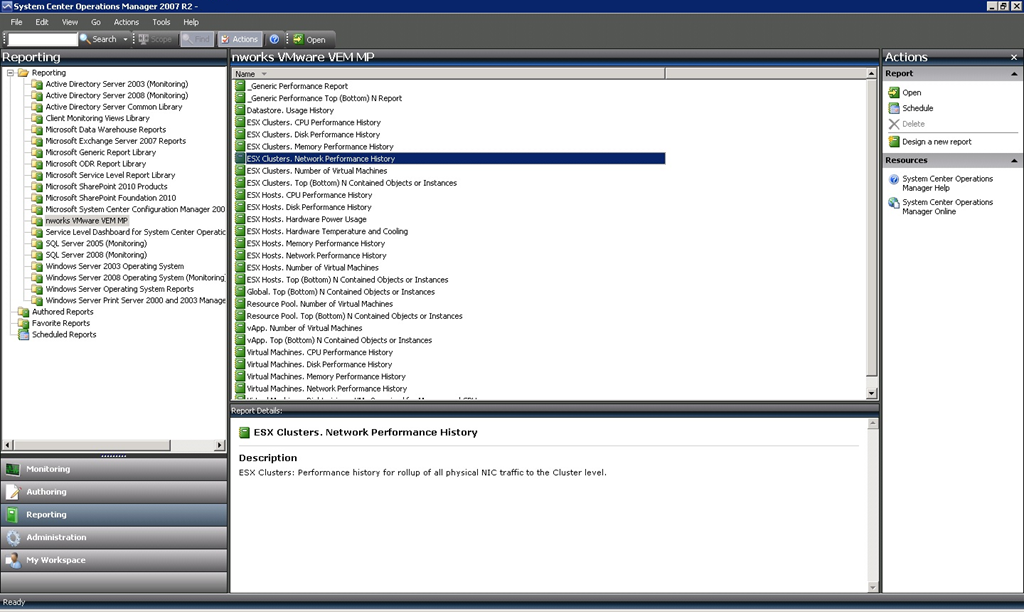
… is the sheer amount of information that it provides.  I previously talked about the monitoring.  That’s great for the reactive side of things.  When I managed infrastructures, I like to take some some to see who things were trending so I could plan.  That’s where reports come in handy, and there’s no shortage of those in this management pack:

image

On my client’s site, we had an alert about latency on a HBA in one of the hosts.  I wanted to give the client some useful information to plan VM placement using affinity rules to avoid this from happening again.  One of the cool reports allows you to create a top-bottom chart of VMs based on a specific performance metric.  The below report was created with with the VMGUEST IOPS metric and shows the top 25 disk activity VMs.

image

As usual with OpsMgr, the report could be scheduled for a time period, and/or saved as a web archive, PDF, word file, etc.  I like this management pack.  Sure, it is pricey (I was told over EUR400/host socket being monitored), but it’s good.  BTW, Veeam did release a 10 socket (enough for 5 hosts with 2 CPUs each) management pack for free, which is available to you under two conditions:

  1. Be a new customer to Veeam AND
    2. Be a SCOM 2012 customer (not SCOM 2007)

Deployed Veeam nworks Management Pack For vSphere

I deployed the Veeam management pack for System Center Operations Manager with a client on their site site yesterday to monitor VMware vSphere.  It was my first production deployment of the solution.  It was pretty simple:

  • Deploy collectors
  • Discover vCenter servers/hosts
  • Monitor
  • Run reports

Oh and the reports!  There’s so many of them with lots of information.  It’s a very nice management pack.  And it accomplishes what the client wanted: they have visibility into VMware from System Center.

Does it work?  Yeap; it detected read latency on a HBA, an oversubscribed VMFS volume (based on potential growth of thin VMDKs), and a full VMFS.

VMware Cloud Management Stuck In The 1990s

Credit to Dave Northey (DPE, MSFT IE) for blogging this one.  VMware’s CTO, Dr. Stephen Herrod says:

VMware Cloud Infrastructure Suite is really more of a marketing term. Those of you know our products deeply know that they don’t fit this well together as they need to. Some of them have multiple databases, some don’t look the same, some install differently, and what I can’t stand that is Site Recovery Manager doesn’t currently work with vCloud Director. So, what we are basically able to say is that we created and acquired companies that led to a lot of individual products that don’t work well enough together yet.

Worse … he was caught on video, as you can see on the link in Dave’s post.  Someone call Tad!

Seriously, I’ve been talking about this for a while.  VMware went and bought a slew of companies in the last few years.  Last year I was at a big VMware event in Dublin where they pushed their “integrated” cloud solution for vSphere.  If by integrated they meant that they changed the icons, grouped them together, and stuck a “v” in front of the name, then they did no better than Amdahl or CA were doing in the 1990’s.  I know; I worked with both product sets back then.  What you got were uncoupled, different, and non-integrated point solutions.  Hardly a cloud at all.

That sort of thing should be buried with grunge rock and rap metal back in that dark, dark decade.

On the other hand, a couple of months ago I was asked to whiteboard the integration of System Center 2012.  I had to tell the people in question that I might as well scribble lines all over the board because it was so deeply integrated.  That’s a modern day, integrated solution for ya!

Survey Finds That vmLimited Customers Prefer Big Cat Wallpapers On Their OS/2 Warp Desktops

A recent survey found that vmLimited customers preferred to use images of big cats for their OS/2 Warp desktop wallpaper.  The same survey found that they also preferred the Phil Collins MiniDisc over the Mariah Carey one.

On the other hand, it was found that System Center 2012 customers preferred to look at dashboards that depicted the health of their private cloud and applications.

Are You vmLimited Like Tad? Go Ahead Punk, Make Me Laugh & Pay Your vTax

image

Meet Tad, he’s a salesman for vmLimited, a company that cannot see beyond virtualisation. 


As any decent IT pro knows, the thing that the company cares about is not that tiny little virtualisation layer, but they do care greatly about the LOB apps that run on the virtualisation platform.  What does Tad think of that?

If you think you’re a cool a cat as Tad thinks he is, then maybe you should get to know him a little more by buying one of his blast-to-the-past tapes:

image

So if you don’t care about the app, if you cannot see beyond virtualisation, if you want to pay not just more, but to be paying a crippling vTax, if you don’t give a damn about the business, and if you can find them, then maybe vmLimited is the platform for you!  How A-Team is that!  I’d sure hate to be a decision maker making that unwise move!

Alternatively, you might want to check out System Center 2012 and where Windows Server 8 Hyper-V is bringing us in just a few months … beyond virtualisation.

EDIT:

On a serious note, the VMware approach reminds me of what I had to work with in the 1990’s … buy up a bunch of systems management point solutions in a short period of time, stuck a –IT on the end of the name, or an A+, or a v- in front of it, call it a framework, say it’s integrated (the logos are changed and grouped together [maybe]) and Bob’s your Uncle.

Hey Ken Hess of ZDNet; You’re a FUD Feeding Fool! Yes, VMware Release Fixes Too

I’ve just read Dear Hyper-V fans, I’ll take that apology now by apparent VMware apologist Ken Hess on ZDNet.  I guess this fanboy who poses as a journalist is upset over the recent hypervisor vote on ZDNet where Hyper-V beat vSphere.

In his article, Hess says:

If you used VMware, you wouldn’t have to reboot your vulnerable systems after patching for the RDP Worm today. Sure, you’ll still have to patch all of your Windows VMs that ride on top of your VMware hosts but at least you don’t have to patch and reboot the VMware host system.

Huh!  Strange that.  Is Hess saying that VMware never releases patches for vSphere?  I think if you follow that link then you might find a different answer to that.  Or maybe the almighty VMware never have to release a security fix for vSphere?  Woops, wrong again Kenny-boy.  Maybe vSphere security fixes don’t require a host reboot?

Host Reboot Required

Yes

Oh it appears they do. 

OK, we don’t have downtime for VMs then?

Virtual Machine Migration or Shutdown Required Yes

Damn.  Ken must have seen something.  I know; patching vSphere must be easy just like it is for Hyper-V (where Automatic Updates, WSUS, System Center Configuration Manager, System Center Virtual Machine Manager 2012, or Windows 8 Cluster Aware Update are all options):

ESXi hosts can be updated by manually downloading the patch ZIP file from the VMware download page and installing the VIB by using the esxcli software vib command. Additionally, the system can be updated using the image profile and the esxcli software profile command

Dagnammit, that sounds like a lot of work to me.  At least the patch is probably small.

297.7 MB

OK, so is Ken Hess just a fill of it, so-called-journalist, FUD fool, or is he just an uneducated moron?  Hey real journalists, I respect your ability to report news fairly, but guys like this do your trade no good.  But I guess maybe Hess isn’t a journalist. 

Maybe he’s a consultant or admin – I’d sure hate to be his client or employer because it appears that Kenny-boy has never checked the vSphere site for patches.  The fact is that any complex piece of code requires bug fixes and security patches.  To deny that … well … to deny that makes you moron.

Me wonders if Windows Server 8 Hyper-V has ‘em scared? Winking smile

Technorati Tags: ,

IDC – 2012 Will Be VMware’s Last Year as King of the Hill

Take a look at the new features of Windows Server 8 Hyper-V.  Now consider that these (and all of Hyper-V) are all built into your VM licensing and you don’t actually have to pay for them.  Buying VMware is an additional cost.

IDC released their predictions for 2012 and #3 is:

2012 Will Be VMware’s Last Year as King of the Hill

To be fair, IDC has also previously claimed that Windows Phone would grab the #2 spot in the market, ahead of Apple *ahem*

But this is different.  Hyper-V right now beats VMware on price, and when you try to reduce VMware pricing, 2008 R2 SP1 Hyper-V beats VMware on functionality.  Windows Server 8 changes that field by dealing with the objections and by doing stuff that VMware doesn’t. And don’t forget that System Center (current and future) smack VMware’s “management” products around like a one-legged little person in a heavyweight MMA fight.

Queue the wailing and gnashing of teeth. I look forward to moderating the comments by VMware marketing Smile

Best Hyper-V Marketing Ever … By VMware … Makes Me Busier Than I’ve Been In Years

I’ve said more than enough about the VMware licensing fiasco from the Summer.  It turns out, that interest in Hyper-V (and System Center) by partners and customers is higher than ever.  And that’s made me busier than ever.  In the past 6 or so weeks I’ve done:

  • 4 corners tour of Ireland road show
  • Countless meetings
  • 3 Hyper-V Immersion events (1 day of crash course education) with 80+ people at each in Dublin.
  • Developed and delivered a bespoke Hyper-V/VMM training course
  • Presented at E2E on Hyper-V (current and future)
  • Done consulting on OpsMgr and ConfigMgr
  • And somewhere in there is a couple of chapters for a book

And between all that and a lull in Hyper-V news, not much blogging was done.  I’ve just had my last scheduled meeting of 2011 and things are quieting down as we head towards the Christmas break.  I’m trying to do a bit of catch up tonight.  I’ve got lab gear on the way for getting into the new stuff.  We’re told a Windows 8 beta is coming in/around the end of Feb.  And that’ll mean there’ll be lots more to talk about.

Technorati Tags: ,,

VMware Can’t See They Got It Wrong With vTax Increases

I’ll keep this one short because the facts speak for themselves.  Earlier this year, VMware announced (and then slightly backtracked) their new v5 licensing model.  VMware introduced a limit on how much RAM each vSphere license would cover.

The impact has been huge.  Locally, I’ve seen hardcore VMware partners (the people who drove demand for vSphere) start to sell Hyper-V.  It seems like free with unlimited feature usage beats vTax with limited license features/capacity every time.

This morning, I read this quote on CRN (VMware to jump on social media bandwagon):

“… if you’re going to move to the cloud the license model has to be cloud-based and not physical-based.” Doug Smith, Global Vice President for Sales, VMware

Huh!  So the license shouldn’t be physical based.  How does that match up with the new RAM limited licensing?