After a 2 week snafu by the local An Post office in my town and me being abroad, I finally gotten my copies of Microsoft Private Cloud Computing this morning.

This is the point when you can finally say “it’s finished”. Now on to other things …
A blog covering Azure, Hyper-V, Windows Server, desktop, systems management, deployment, and so on …
After a 2 week snafu by the local An Post office in my town and me being abroad, I finally gotten my copies of Microsoft Private Cloud Computing this morning.
This is the point when you can finally say “it’s finished”. Now on to other things …
Last Sunday Wiley released the electronic version of Microsoft Private Cloud Computing in Amazon Kindle, and other formats such as iTunes.
Oddly enough, the paper version is usually released before the digital ones. I know that sounds backwards but it has always been my experience. I can confirm that the paper editions are actually available. There seems to have been an issue with distribution so Amazon still don’t have stock but should have soon.

If you want to learn how to use System Center 2012 to build and manage the fabrics of your private cloud then you can go to Amazon and buy Microsoft Private Cloud Computing. It’s available on Kindle now … even before any of the authors have seen the finished product 
I just saw this tweet by Damian Flynn, regarding the book Microsoft Private Cloud Computing (Sybex, 2012):
#MsftPrivateCloud And it is done, that final edits have being submitted and the printer takes ownership tomorrow!
Hans, Patrick and Damian did in incredible amount of work on this book. In fact, Damian went the extra mile *twice* (or was it three times?  ) to make sure the reader got the very best and latest information on this solution (it’s hard writing a book on something before it RTMs). Gentlemen, I salute you!

Amazon has a date of July 3rd posted. That’s not always accurate. And yes, there will be ebook versions, such as Kindle. Don’t ask me when – you’ll know before I do.
Considering that Microsoft has just started their Microsoft Private Cloud/System Center 2012 campaign with their “transforming IT” production, it was thought that this was the perfect time to announce a new book, Microsoft Private Cloud Computing:

“Written by a team of expert authors who are MVPs and leaders in their respective fields, this one-of-a-kind book is an essential resource for IT administrators who are responsible for implementing and managing a cloud infrastructure. You’ll quickly learn how cloud computing offers significant cost savings while also providing new levels of speed and agility. Serving as a how-to guide, Microsoft Private Cloud Computing walks you through building a secure, internal cloud and delivering it as a service to your company suing Microsoft Windows Server Hyper-V and Microsoft System Center Virtual Machine Manager 2012.
Microsoft Private Cloud Computing is a must-have comprehensive resource that covers all aspects of implementing a private cloud”.
And just who are these “expert authors”. Let me introduce them to you:
There’s a long story behind the book. It started out with one concept that was talked over initially via email and a chat. Then when we started to get to grips with the concept … well … everything took a left turn at Dundalk and went a different direction. The size and complexity of the project literally blew up as we figured out what we really needed to write about. That’s when we needed to add more expertise … and boy did we do that in style!
Credit where credit’s due, after the initial concept development and planning, I stepped back a wee bit and took care of the intro chapters. I had a l-o-n-g period of writing in 2010 and I wanted to take a break from it in 2011. The meat of this book has been written by Patrick, Damian, and Hans. Technical reviewing is being handled by Cloud and Datacenter Management MVP, Kristian Nese (@KristianNese), helped by the fact that he has already published a book called Cloud Computing in Norwegian.
FYI, the cover that’s available now is a preliminary artwork … hence my cloning out the author listing. It will be updated to reflect the work done by Hans, Damian, and Patrick.
It is estimated that Microsoft Private Cloud Computing will be available on May 22nd, 2012. And yes, I would expect there to be ebook editions – just don’t ask me when.
Nathan Winters, one of the authors behind Mastering Lync Server 2010, tweeted me last night to let me know that my Hyper-V book, Mastering Hyper-V Deployment, is for sale in the company store at Microsoft headquarters in Redmond, WA, USA. I guess I’m officially successful now  At least it’s beside all the Cloud and Azure books and not in the bargain bin
Nathan had the “pleasure” of being my roommate at MVP Summit 2010 when I first saw the book in a shop in nearby Bellevue. Yes, I did go back a second time to admire the view.
Thanks Nathan!

I was bouncing about on Amazon and noticed some books for System Center Configuration Manager 2012.
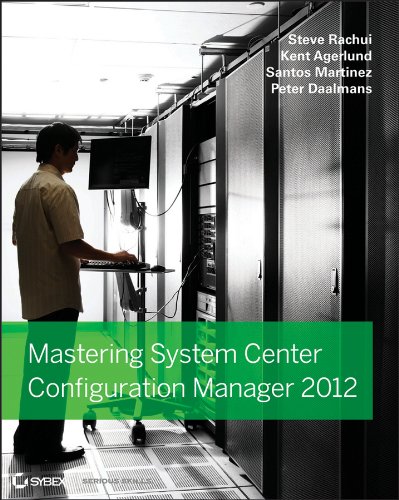
I’ve done some writing for Sybex so Mastering System Center Configuration Manager 2012 (due in March 2012) is the first one I’ll mention. The blurb:
The latest version of System Center Configuration Manager (SCCM) is a dramatic update of its predecessor Configuration Manager 2007, and this book offers intermediate-to-advanced coverage of how the new SCCM boasts a simplified hierarchy, role-based security, a new console, flexible application deployment, and mobile management. You’ll explore planning and installation, migrating from SCCM 2007, deploying software and operating systems, security, monitoring and troubleshooting, and automating and customizing SCCM 2012 with scripts.
Packed with real-world scenarios to show you how to use SCCM in various contexts, Mastering System Center Configuration Manager 2012 covers all aspects of this powerful and complete network software deployment tool.
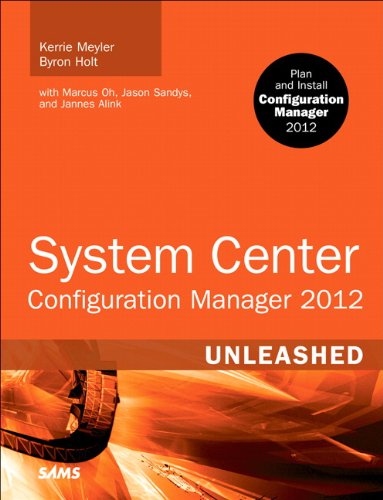
I read the Unleashed book for ConfigMgr 2007 and thought it was good. This is the successor, System Center Configuration Manager 2012 (due in April 2012). This book’s blurb is:
This is the first and only comprehensive reference and technical guide to Microsoft System Center Configuration Manager 2012. A team of expert authors offers step-by-step coverage of related topics in every feature area, organized to help IT professionals rapidly optimize Configuration Manager 2012 for their requirements, and then deploy and use it successfully. The authors begin by introducing Configuration Manager 2012 and its goals, and explaining how it fits into the broader System Center product suite. Next, they fully address planning, design, and implementation. Finally, they systematically cover each of Configuration Manager 2012’s most important feature sets, addressing issues ranging from configuration management to software distribution. Readers will learn how to use Configuration Manager 2012’s user-centric capabilities to provide anytime/anywhere services and software, and to strengthen both control and compliance. The first book on Configuration Manager 2012, System Center Configuration Manager 2012 Unleashed joins Sams’ market-leading series of books on Microsoft’s System Center product suite: books that have achieved go-to status amongst IT implementers and administrators worldwide
Best of luck to the authors; they’re probably busy writing away right now with deadlines coming in all directions.
Hmm, I wonder what ISBN 9781118251478 might be …
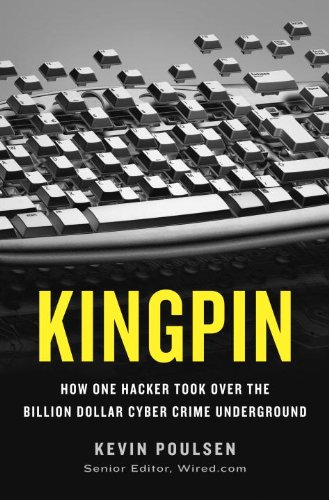
I just started reading this book during lunch today – when possible, I like to get out of the office for an hour to do something that is not at the desk.
There’s been a lot of movies, TV shows, and books about hacking. I imagine that it isn’t a world full of bikini-clad babes clicking on a mysterious Pi symbol on The Net, or people with multi-coloured pencils in their hair typing out >Go Hack Now with instantaneous results. The description of this book, Kingpin, got me interested. It’s a story with the insider’s perspective:
In a previous life, Poulsen served five years in prison for hacking. So the Wired senior editor and "Threat Level" blogger knows intimately the terrain he explores in this page-turning tale of the criminal exploits of a hacker of breathtaking ambition, Max Butler, who stole access to 1.8 million credit card accounts. Poulsen understands both the hows of hacking, which he explains clearly, as well as the whys, which include, but also can transcend, mere profit. Accordingly, his understanding of the hacking culture, and his extensive interviews with Butler, translates into a fascinating depiction of a cybercriminal underworld frightening in its complexity and its potential for harm, and a society shockingly vulnerable to cybercrime. The personalities, feuds, double dealing, and scams of the hackers are just one half of this lively story. The other half, told with equal verve, is law enforcement’s efforts to find and convict Butler and his accomplices. (Butler is now serving a 13-year sentence and owes .5 million in restitution.) Poulsen renders the hacker world with such virtual reality that readers will have difficulty logging off until the very end.
But the question remains – does the president get saved in 24 hours? I’ll post a review when I’ve finished reading it.
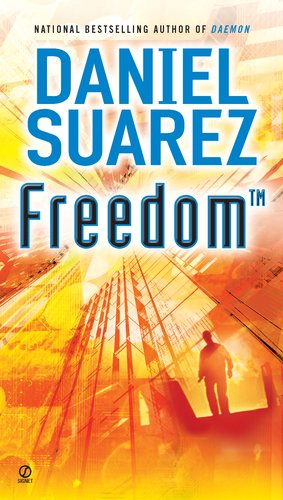
Freedom ™ (the tm mark is important!) is the sequel to the last book I reviewed, Daemon, also by Daniel Suarez. The story continues and accelerates from the cliff hanger.
I won’t give anything of the plot away. This is a thriller. IT and cyber security are mechanisms in the plot but they don’t dominate, and importantly, they don’t steal from it. The tech does stretch a little further into the sci-fi realm than Daemon, but it’s grounded enough to not be a distraction.
I’ll sum it up; the first thing I did when I reached the last page was check if the next book by Suarez was published yet. I’d recommend Freedom ™ but only after you read Daemon.
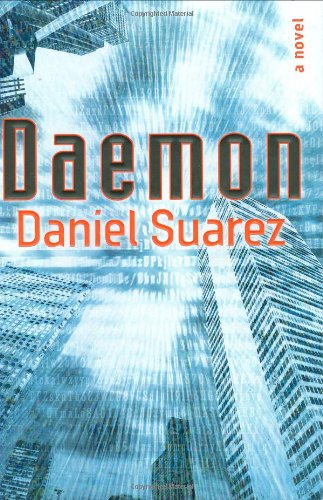
The story of Daemon is that a games development genius dies, but that doesn’t stop him from wreaking havoc on the world. Before he dies, he uses the AI from his games to create a distributed network to enact his will.
This book has what Zero Day didn’t: a hook, something to keep you turning the pages. In fact, I found it quite addictive. I was reading it before work, at lunch, and going to bed early to read more. I finished it this morning and immediately ordered/downloaded the sequel, Freedom.
Whereas Zero Day featured an extremely believable scenario, Daemon goes a little bit more into the sci-fi end of things to add an element of danger. However, it is still rooted in the believable. I can’t watch a movie or read a book that features “go hack now” scenarios. But this book was based on things like trojans, in-game AI, RSS feeds, GPS, and so on. It just stretched what we know about a little to enable the plot, but kept this acceptable an acceptable limit for me.
Over and over, in this book, you’ll see how hacks take advantage of poor patch control. Spotting a trend?
I reckon that if you work in IT, or find computers interesting, then there’s a really good chance that you’ll like Daemon. This book can be ordered on Amazon.com.