Inspire 2017 Day 1 Keynote

What We Know So Far

There’s been lots of talk and sharing about Azure Stack. Lenovo and HPE have opened up orders. Microsoft has also announced availability of the Azure Stack Development Kit, the free single-server deployment (what we saw in the Preview program).

A DJ is DJ-ing on a Surface Studio and tells us to turn off our phones. And now we get an inspirational video on MS and Washington. Then someone talks about mountain climbing and dreams and stuff.

Ron Puddleston – One Commercial Partner VP

Over 17,000 people at the keynote – or trying to get in because security is supposed to be creating a nightmare there. Lots of “partners are great” and “partners are great”.

image

Partner feedback, according to him, was the MS wanted one way to be in contact with MS, and one way to interact with customers. They wanted one voice to advocate for them. And that’s why MS created “One Commercial Partner” group from SMS&P, EPG and other organizations last week. It’s to be “partner first”. It’s supposed to be simple and aligned to how partners work:

  • Build the business
  • Go to market
  • Sell with partners to customers

That’s supposed to be what OCP (sounds like Robocop) does. They are measured on partner growth, not individual product sales. They’re investing €250,000,000 to connect partners with customers. The GM is to connect partners to customers – this is not a partner account manager as the past. He says “the right partner for the customer” – big emphasis this FY by Inside Sales on partners with competencies. Two new things:

  • Focus on Azure billed revenue caused frictions for partners. Azure consumed revenue is now the goal. That only affects EA customers because they’re the same in CSP.
  • MS reps will be recognized for 10% of the value of co-sold ISV products.

One partner team will offer all this.

Satya Nadella

image

He says the partner conference sets the tone for the rest of the MS financial year – it’s a highlight for him. 140 countries represented at the conference. There are currently 17 million jobs around the world because of MS partners. There are 64,000 partners leading with cloud solutions. Partners coming into the MS cloud from other ecosystems: Linux, Hadoop, Java.

They’ve been talking about mobile first/cloud first for years and been getting loads of feedback from MS partners’ digital transformation stories. Moving towards Intelligent Cloud/Intelligent Edge. 3 characteristics:

  1. Every experience that is built is multi-device and multi-sense. Might be speech on one, ink on another, touch on another.
  2. Infusion of AI – in every application experience that will be built. An autonomous car will generate 4 GB of data per second. That’s one car per second. That data has “gravity”. AI is being distributed to devices, not just in data centres.
  3. Managing all of this complexity requires a new efficient frontier for application development, distribution and management. This is about serverless tech, such as containers, functions, logic apps, etc.

image

The opportunity is bigger than ever before and growing. Microsoft has a history of jumping on platform shifts. The PC was democratized. Then client/server. There is $4.5 trillion of spend here. The product and the service are digital.

image

We will all thrive if we do the above by geography and by industry. Modern Workplace, etc above, are the framework.

Modern Workplace is where he starts. Empower people inside of your organization – brings a shift in culture and the early signal of digital transformation. Lots of CEOs in a video about changing business to be self-empowered, nimble, competitive, creative, etc.

image

The demographics of the workplace are changing. Skills are changing. How teams come together is changing. Teams are dynamic, traditional IT is not. Bring the systems into one simple framework. Need sophistication to protect the many endpoints for user access and data flow. Need operational insight to detect and respond to attacks.

Microsoft 365

Coming together of Office 365, Windows 10, and EMS. Two offerings: Enterprise (was Secure Compute Enterprise SKU) and Business (for SMEs).The 4 pillars are:

  • Creativity
  • Teamwork
  • Simplicity
  • Security

Demo coming up. Sonia Dara starts with an iPhone-base demo.

I had to leave at this point for a customer Skype call … interesting timing Smile

Upcoming Webinar: 4 Important Azure IaaS features for building your Hybrid Cloud

I’m going to be presenting in a webinar by Altaro on July 18th. It’s an interesting topic, Azure, because lots of IT pros are wondering if/how they’ll use Azure and how they should get started. As an IT pro, your first ventures into The Cloud will probably be infrastructure, so I’ll talk about a few topics that will hopefully get you better prepared.

Altaro has a big audience around the world, so the webinar will be run twice:

  • Time for EU attendees: (2pm CEST)
  • Time for US attendees: (10am PDT / 1pm EDT)

image

Azure Backup Central Reporting – Pay Attention MS Partners!

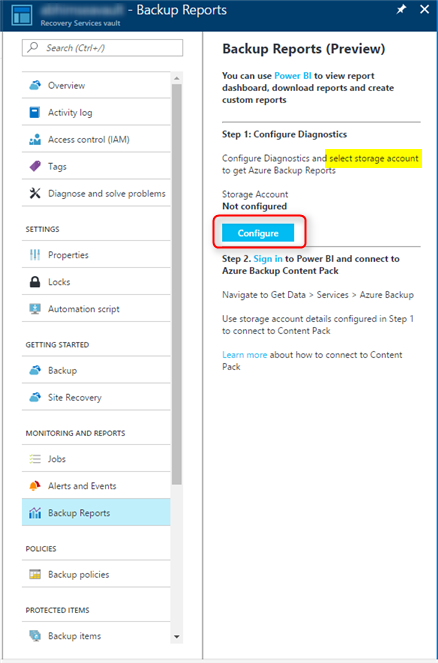
Microsoft has launched a preview of Azure Backup Reporting; this is a solution where you can export backup data to Power BI, and this allows you to consume, visualize, and subscribe to information about backup from many recovery services vaults in many subscriptions.

The way the system works is that you configure the recovery services vault to export data regularly to a storage account (must be in the same tenant as the recovery services vault).

Configure storage account step 3

You then sign into Power BI (a free subscription can be used but this is limited to 1 GB of data) and import the Azure Backup content pack.

Import content pack

Data is exported as JSON files into a folder (container) in the storage account, and Power BI will consume/process that data. The timing of this varies on the data, but Microsoft advises that it can take 24 hours for your first data sets to be consumed.

Azure Backup Reports data push frequency

The default screens show lots of useful information:

  • Summary of job health
  • Cloud storage usage
  • Quantities of instances
  • Cloud storage growth trends

Azure Backup dashboard

While the solution is not perfect yet (read more and vote here) it can be used today. Note that DPM, MABS, and Azure VM backup are not supported yet by the preview. I have set up 3 demo subscriptions (each in a different tenant as is normal for deployments by MS partners), each with a MARS backup job. I imported the Azure Backup content pack 3 times, 1 for each tenant. I made a custom report for each subscription and pinned them to a single dashboard. Now I can see the results of each and every backup job in one screen. I can also create daily/weekly email subscriptions to each report – that means I can send out these reports to my customers!

image

I can also publish the reports either to a web site or a private SharePoint (including Online) site – here’s an example that I did for work.

image

The end result is that we finally have a centralized reporting solution for Azure Backup. With one quick scroll, I can easily see the health of all of my customers’ backups.

Year 10 as an MVP – Adding The Azure Expertise

Today was a stressful day – it was the annual date of my MVP renewal. The program has changed quite a bit in the last year, and this is the only renewal date from now on, so you might have seen more MVPs than usual sharing their nerves online.

I was extremely nervous, especially because my profile on the MVP directory went offline. I was sure that I was a goner. But later in the day my profile re-appeared, with a change.

NewMVPStatus

To mark year 10 as a Microsoft Valuable Professional, I have been awarded with a double expertise:

  • Cloud & Datacenter Management (Hyper-V)
  • Microsoft Azure

And a little later in the afternoon, the notification email arrived:

MVP2017Email

My eldest daughter, who is 10 years old, had noticed my stress and wanted to congratulate me. I was banished from the kitchen and later I was presented with this cake – I’m a proud Dad:

MVP10Cake


These are fun times ahead for IT pros. My double status, with on-premises virtualization and public cloud, mirrors what’s going on in many of our careers, either already or pretty soon.  My career has changed so much over the years:

  • UNIX programmer
  • Have-a-go-hero Windows consultant
  • Re-inventing myself to be a better Microsoft engineer
  • Senior sysadmin in an international company
  • MVP in SCCM
  • Virtualization engineer
  • MVP in Hyper-V
  • Author
  • Technical sales
  • Writer
  • Lead on Azure IaaS
  • MVP in Azure

And now I can see somewhat of a return to development. I don’t see myself coding, but I’m heading to Ignite with the intention of spending as much time as posisble learning PaaS stuff, while trying to figure out what’s happening in Windows Server 1709, Azure IaaS developments, and soooo much more!

Big Changes to Windows Server–Semi-Annual Channel

Microsoft has just announced that they are splitting Windows Server and System Center into two channels:

  • Long-Term Servicing Channel (aka Branch)
  • Semi-Annual Channel

Long-Term Servicing Channel

This is the program that we’ve been using for years. Going forward, we will get a new version of Windows Server every 2-3 years. This big-bang release is what we are used to. We’ll continue to get 5 years mainstream support and 5 years extended support, and recently Microsoft announced the option to pay for an extra 6 years of Premium Assurance support.

Existing installations of Windows Server will fall into this channel. This channel will continue to get the usual software updates and security updates every month.

Semi-Annual Channel

This is aimed at hosting companies, private cloud (Azure Stack), and other customers that desire the latest and greatest. In addition to the usual monthly updates, these customers will get an OS upgrade, similar to what happens with Windows 10 now, twice per year in the Spring and Autumn.  Each of these releases will have 18 months of support after the initial release. Most of the included features will be rolled up to create future Long-Term Servicing Channel builds. While the Long-Term Servicing Channel releases will probably continue to be named based on years, the Semi-Annual Channel will use build numbers. A theoretical release in September 2017 would be called version 1709, and a March release in 2018 would be called version 1803.

Customers who can avail of this option are:

  • Software Assurance customers
  • Azure marketplace
  • MSDN and similar programs

SPLA wasn’t mention but this surely would have to be included for hosters?

Impact

The first word that came to my mind was “confusion”. Customers will be baffled by all this. MS wants to push out updates to more aggressive customers, but most companies are conservative with servers. The channel had to split. But it shall be fun to explain all of this … over and over … and over … and over … and again.

Microsoft Azure Backup Server v2 Launched

Microsoft has launched version 2 of MABS, the Microsoft Azure Backup Server v2, with support for Windows Server 2016 and vSphere 6.5.

image

So far we’ve had 2 versions (v1 and v1 update 1) of MABS, the freely licensed (but your pay Azure Backup pricing) slightly modified version of System Center Data Protection Manager. MABS v1 was based on DPM 2012 R2, and MABS v2 is based on DPM 2016, with the cool features of DPM 2016:

  • Modern Storage, which improves performance and reduces consumption by leveraging ReFS Block Cloning, VHDX, and Deduplication.
  • Improves Hyper-V backup, by supporting WS2016 hosts and by using the built-in (WS2016 Hyper-V) Resilient Change Tracking (RCT) for incremental backups without 3rd party software being placed into the kernal of the host’s management OS.
  • Support for Shielded Virtual Machines, the ultra-secure platform on WS2016 Hyper-V.
  • Support for Storage Spaces Direct (S2D).
  • The ability to install MABS v2 on WS2016.

MABS v1 Update 1 added support for VMware vCenter & ESXi 5.5 and 6.0. MABS v2 adds vCenter & ESXi 6.5 to the list. Note that if you install MABS v2 on WS2016 then VMware protection will be in preview mode, while we wait for VMware to release support for VDDK 6.5 for WS2016. You can learn more on from this video.

You can download MABS v2 from here or from a recovery services vault in the Azure Portal.

The supported backup server configuration is:

  • Windows Server 2012 R2, Windows Server 2016
  • Processor: Minimum: 1 GHz, dual-core CPU. Recommended: 2.33 GHz quad-core CPU
  • RAM: Minimum: 4GB. Recommended: 8GB
  • Hard Drive Space (program files): Minimum: 3GB, Recommended: 3GB
  • Disks for backup storage pool: 1.5 times size of data to be protected

Microsoft Azure Backup MARS Agent Supports System State

Microsoft has announced that the Azure Backup MARS agent will support the protection of System State on Windows Server. This is a preview release.

I started talking about Azure Backup 3 years ago, and one of the “we’re not doing it” questions was “does it backup system state”. The answer was no. Azure Backup listened and now you can backup your system state to Azure using the MARS agent.

Scenarios discussed by the Azure Backup team include Active Directory, file server configurations, and IIS server configurations, where restoring files & folders is not enough; the metadata that makes those files & folders useful is stored in System State so the ability to restore that meta data is also important.

Supported versions of Windows Server in this preview release are:

  • W2008 R2
  • WS2012
  • WS2012 R2
  • Windows Server 2016

Do you want support for Windows Server 2003? Let me sell you some Ace of Base and Vanilla Ice cassettes!

This is good news, a part of the continuous improvement of Azure Backup driven by your feedback.

Azure Hybrid Use Benefit – Not As Beneficial As You Might Think!

This is a licensing post. I will not be answering any licensing questions. If you have any licensing questions then please send them to an account manager at your licensing supplier. No exceptions!

Microsoft has been making quite the fuss about a new benefit of Software Assurance for Windows Server called Azure Hybrid Use Benefit.

Whether you’re moving a few workloads, migrating your datacenter, or deploying new virtual machines (VMs) as part of your hybrid cloud strategy, the Azure Hybrid Use Benefit (HUB) provides big savings as you move to the cloud.

You can make use of this licensing benefit in a few technical ways when deploying VMs in Azure. You can choose the [HUB] images from the Marketplace (manually or via JSON/PowerShell) or you can check a box in the Create Virtual Machine blade:

image

The implied message is that for every machine you have covered by SA, you can get 40% (or more) savings by being charged for the VM minus the cost of Windows (Linux VM pricing). Well, that’s sort of true. When you dig a little deeper you’ll learn a few things.

Standard Versus Datacenter

The SA benefit of HUB works differently if you have Std or DC licensing. If you have a Windows Server Std license with SA then you can use this benefit when moving the licensed machine to Azure. You’re not getting anything extra here … just the ability to move your license.

If you have Windows Server DC license with SA, then you can use this benefit to deploy additional Windows VM licensing in Azure.

What Do You Get?

The devil is in the details.

For every 2-processor Windows Server license or Windows Server license with 16-cores covered with Software Assurance, you can run either of the following at the base compute rate:

  • Up to two machines with up to 8 cores or
  • One virtual machine with up to 16 cores.

Let’s assume that you have licensed a new host with Windows Server 2016 with SA. That host has 16 cores. From that license we are getting HUB licensing for Windows Server for either:

  • 2 VMs with up to 8 cores each, e.g. a pair of DS2v2s OR
  • A single VM with up to 16 cores.

If you bought WS2016 Std, then all you get is the ability to move either that physical machine or 2 VMs from that machine (AND decommission the host) to Azure.

If you bought WS2016 DC, then you think “that covers all my VMs”. Yes; it does for on-premises licensing. But HUB still only gives you the above 2 options for the physical host’s license. The VMs don’t have licenses, so you get the same amount of licensing as Std edition, but at least you can keep your on-premises stuff and add new HUB VMs in Azure.

Bigger VMs in Azure

If you need more cores in your Azure VMs then you can stack licenses. You can take 2 on-premises licenses and “stack them” to get 16 + 16 cores for an Azure VM with up to 32 cores.

Compliance

I haven’t completed a deployment of a HUB VM, so I am not 100% sure of this, but I don’t think that there is anything more than an honour system to this type of licensing. It’s up to you to verify that you have correctly licensed your Azure VMs. Azure is probably the next frontier for licensing auditors, so don’t fall into any easy traps that they can roast you in.

Don’t Buy SA for HUB

Don’t get me wrong, HUB is a nice add-on but it’s not going to make a huge difference for companies with lots of virtualization. It’s a nice perk but it’s not why you attach SA to your hosts. You do that for lots of other reasons, such as Cold Server Back UP Recovery, upgrade rights, adding mobility to OEM licenses, and more.

Got Any Questions?

I won’t be answering them. Please ask an account manager at the supplier of your licensing.

StorSimple–The Answer I Thought I’d Never Give

Lately I’ve found myself recommending StorSimple for customers on a frequent basis. That’s a complete reversal since February 28th, and I’ll explain why.

StorSimple

Microsoft acquired StorSimple, a physical appliance that is made in Mexico by a subsidiary of Seagate called Xyratex, several years ago. This physical appliance sucked for several reasons:

  • It shared storage via iSCSI only so it didn’t fit well into a virtualization stack, especially Hyper-V which has moved more to SMB 3.0.
  • The tiering engine was as dumb as a pile of bricks, working on a first in-first out basis with no measure of access frequency.
  • This was a physical appliance, requiring more rackspace, in an era when we’re virtualizing as much as possible.
  • The cost was, in theory, zero to acquire the box, but you did require a massive enterprise agreement (large enterprise only) and there were sneaky costs (transport and import duties).
  • StorSimple wasn’t Windows, so Windows concepts were just not there.

Improvements

As usual, Microsoft has Microsoft-ized StorSimple over the years. The product has improved. And thanks to Microsoft’s urge to sell more via MS partners, the biggest improvement came on March 1st.

  • Storage is shared by either SMB 3.0 or iSCSI. SMB 3.0 is the focus because you can share much larger volumes with it.
  • The tiering engine is now based on a heat map. Frequently accessed blocks are kept locally. Colder blocks are deduped, compressed, encrypted and sent to an Azure storage account, which can be cool blob storage (ultra cheap disk).
  • StorSimple is available as a virtual appliance, with up to 64 TB (hot + cold, with between 500 GB and 8 TB of that kept locally) per appliance.
  • The cost is very low …
  • … because StorSimple is available on a per-day + per GB in the cloud basis via the Microsoft Cloud Solution Provider (CSP) partner program since March 1st.

You can run a StorSimple on your Hyper-V or VMware hosts for just €3.466 (RRP) per appliance per day. The storage can be as little as €0.0085 per GB per month.

FYI, StorSimple:

  • Backs itself up automatically to the cloud with 13 years of retention.
  • Has it’s own patented DR system based on those backups. You drop in a new appliance, connect it to the storage in the cloud, the volume metadata is downloaded, and people/systems can start accessing the data within 2 minutes.
  • Requires 5 Mbps data per virtual appliance for normal usage.

Why Use StorSimple

It’s a simple thing really:

  • Archive: You need to store a lot of data that is not accessed very frequently. The scenarios I repeatedly encounter are CCTV and medical scans.
  • File storage: You can use a StorSimple appliance as a file server, instead of a classic Windows Server. The shares are the same – the appliance runs Windows Server – and you manage share permissions the same way. This is ideal for small businesses and branch offices.
  • Backup target: Veeam and Veritas support using StorSimple as a backup target. You get the benefit of automatically storing backups in the cloud with lots of long term retention.
  • It’s really easy to set up! Download the VHDX/VHD/VMDK, create the VM, attach the disk, configure networking, provision shares/LUNs from the Azure Portal, and just use the storage.


So if you have one of those scenarios, and the cost of storage, complexities of backup and DR are questions, then StorSimple might just be the answer.

I still can’t believe that I just wrote that!

Speaking At European SharePoint, Office 365 & Azure Conference 2017

I will be speaking at this year’s European SharePoint, Office 365, and Azure Conference, which is being held in the National Conference Center in Dublin between 13-16 November. I’ll be talking about Azure Site Recovery (ASR):

image

It’s a huge event with lots of tracks, content and speakers from around the world.


For those of you in Ireland, this is a rare opportunity to attend a Microsoft-focused conference of such a scale here in Ireland.