SCE 2010 and DPM 2010 RTM

Data Protection Manager 2010 and System Center Essentials 2010 were both announced as being released to manufacturing today.

DPM is MS’s backup solution and is the one that has the ability to backup a Hyper-V CSV.  The catch is that it puts the CSV into redirected IO mode.  Thus the preference is to use a storage provider with a supported VSS provider.  That allows you to safely backup running VM’s and maintain database consistency when recovered  -> VSS runs all the way through the stack.  You can even recover single files!

SCE 2010 is the all-in-one package that has the best of ConfigMgr, OpsMgr and now with VMM so you can manage W2008 R2 Hyper-V.  This makes it the ideal systems management solution for small-medium companies.

KB2022557: Selecting RedHat in VMM Fails

Microsoft has posted a fix to enable you to select RedHat as the OS of a VM in VMM 2008 R2, 2008 and 2007.  Without the fix you get this error:

Error (10637)

The virtualization software on host <server> does not support the Red Hat Enterprise Linux 5 operating system.

The problem is that the VMM database needs a tiny adjustment.  You can do this easily enough using SQL Management Studio or SQL Management Studio Express.  First, you should back up the database (don’t come crying to me if you didn’t!).  You then need to create a new query with the following:

update tbl_IL_OS

set OSFlags=0x14

where Name like ‘Red Hat Enterprise Linux 5%’

Run the query and you should be sorted.

Technorati Tags: ,,,

What Would The Interest Be In a Training Day?

I’m just thinking aloud here.  If I was to do a training day on deploying Hyper-V in an enterprise, what would the interest be? 

  • It would probably be in Dublin, hopefully near the airport – making it possible for people to get cheap flights in that morning and fly home that night.
  • The session would be 1 day long.
  • The cost would be around €200 per person. 
  • It would include everything in the project, from assessment through to backup and recovery of the system.
  • The latest developments would be included – there are always new developments in the Hyper-V world.  It is far from boring.

No promises – and it’s certainly not happening before August.  I’m just curious what people think.

Some Useful Hyper-V Posts From the Last While

I’ve been going through my unread feeds from the last month or so (it’s been busy) and I’m posting links to the interesting ones here:

So … What Exactly Am I Writing?

You can tell I’m pretty busy because my usual high rate of blogging has dropped significantly in the last month.  Apologies for that.  The blogging has become writing.  I am involved in 2 book projects.  I’ve just seen on Twitter that details on one of those has just gone public.  I actually just saw the tweet seconds after I sent off a chapter I just finished.

Earlier this year I proposed an idea for a Windows Server 2008 R2 virtualization book to Wiley Publishing/Sybex.  It took quite a bit of work to tune the proposal.  It requires an understanding of the subject matter, the audience, and ideas on how it can be marketed.  You could think that a brief overview on the subject matter would be enough.  But no, the publisher needs much more detail.  You pretty much have to provide a detailed project plan for every heading (3 levels deep), page estimates and time estimates.  The proposal evolved over the weeks and eventually went through a couple of reviews.  I then got the news: an ISBN number was assigned and contracts were on the way – I was going to be a lead author on my own book for the very first time!!!!  I did get drunk that night – I think.

The deadlines are very tight.  I was considering seeking help.  My contact in Sybex advised that I outsource some of the chapters to a co-author.  I knew the person I wanted to bring in.  Wilbour Craddock is a technical specialist in the partner team with Microsoft Ireland.  Will (Irish folks will know him as the crazy Canadian who is always wearing shorts) is also a former SBS MVP.  His job has him spending a lot of time working with Hyper-V and Microsoft System Center, making him a perfect co-author to work with on this project.  Thankfully, Will agreed to hop on board the crazy train of book writing.

Another MVP (I won’t say who yet because I don’t have permission to name him) is the technical editor under the employment of Sybex.  He’s an ace at this stuff and will make sure everything we do is up to scratch.

The book is called Mastering Hyper-V Deployment.  I won’t go into the details of it yet.  But you can bet that it is based on our collective experience and knowledge of the product set involved in a Hyper-V deployment.  I saw a gap in the market and figured I could probably write (or a good chunk of) the book to fill it.  The estimated release is in November 19th of this year.  That means we need to finish writing in July.  It has started to appear on some sites for pre-order.

I’m two chapters in a the moment.  I’m really pushing my hardware at home to its limits and am “this close” to buying more.  Will is ahead of schedule and has one chapter nearly done.

I am also working on another book project as a co-author for a friend’s book.  It’s another on-subject book that is turning out to be a good experience.  I’ve one chapter done on that and am 50% through the other.  I’ll talk more about that when the time is right.

As you may have read in my previous posts about my chapters in Mastering Windows Server 2008 R2, the original draft edit is just the very start of the process.  There are numerous technical, language, layout and copy edits for each and every chapter.  It’s a lot of work but it’s a great experience.  And I can’t wait for the buzz to see my name as the lead author of a book in a book shop.  I had to really try when I saw Mastering Windows Server 2008 R2 in Barnes & Noble over in Belleview WA back in February.

My Current Hyper-V & Writing Lab

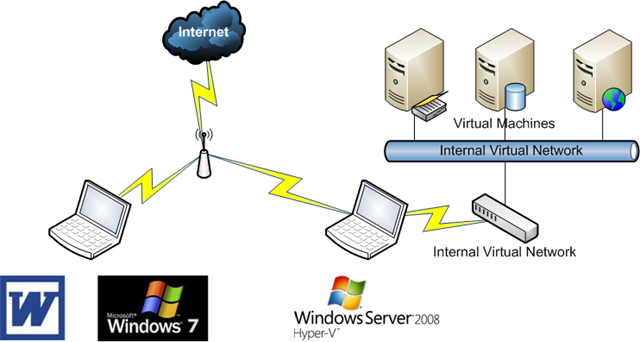
I’m working on a couple of writing projects after work at the moment and I thought I’d talk a little bit about how I’m doing my lab work.  I’ve previously talked about how I’m using Hyper-V on my Dell E6500 laptop.  With a few projects going, you can imagine how far I’m pushing it!

image

At the moment, I’m using two laptop.  My old Sony Vaio is running Windows 7 and Microsoft Office 2007.  Why not 2010?  I’m using a customised ribbon that is version specific.  That allows me to use all the formatting that the publisher requires.

My Dell E6500 (Dual Core CPU, 8GB RAM) is running Windows Server 2008 R2 Datacenter edition from an 7200 RPM 250GB eSATA hard disk.  Normally it boots from Windows 7 using the internal hard disk.  But I’ve set up the BIOS to boot from eSATA first if it is found.  On there, I’ve enabled the Hyper-V role, configured the machine as a domain controller and installed VMM 2008 R2.  None of that is good production practice!  DNS is also enabled on the parent partition and uses forwarders for Internet name resolution.

The laptops are on my wifi network at home.  Hyper-V does not support wifi for virtual machine networking.  However, there’s a well known way to create an internal virtual network and bridge it with the wifi NIC in the parent partition.

I started out keeping my VM’s in a folder on the C: drive.  However, 250GB runs out pretty quick.  Compressing the VMM library did help a bit here.  I ended up using a USB 2.0 external drive for additional space.  Sure the performance sucks, but I’m doing lab work, not production server hosting!

The laptop has 8GB of RAM.  I want to make the very most of every MB of RAM.  So I enable RDP on my VM’s. That way I don’t even have to log into the Hyper-V laptop once things are up and running.

This allows me to work away on the documentation on my Vaio.  I can RDP from there onto my VM’s which are on the same network (with static IP’s).  I’m using a tool called MWSnap to capture screenshots to TIF files.  They auto save to a shared folder on the parent partition, which I copy over to the VAIO every now and then.

As much as I can squeeze out of this, I’m realistically looking at deploying more hardware.  I’m still going back and forth on pulling the trigger on that purchase.
New Linux Integration Components Beta

A while ago, I asked for some feedback on Hyper-V and VMM.  Some of the strong feedback came on the Linux guest side.  In particular, the integration components:

  • The lack of shutdown integration.
  • Only 1 virtual CPU supported.
  • The lack of time synch between host and guest recently affected me.

Never fear, MS was ahead of me.  Ben Armstrong just let the public know that new integration components are in the works and you can download these new beta (test) IC’s from Connect now.  The IC’s are for the usual supported Linux distros (SLES and RHEL).  Supported is different to “it works”, i.e. these will probably work just as well on Ubuntu and CentOS but MS cannot support them.  They will also support all Hyper-V variants.  The new features are:

  • SMP support for up to 4 virtual CPU’s (Yay!)
  • Shutdown integration between host and guest, e.g. host shutdown or from VMM
  • Clock synch between host and guest (no more run away clock and NTP fixes)

Ben also says that the new functionality will be submitted to the Linux kernel.  Here’s hoping the Linux distros keep up to date.

Technorati Tags: ,,

MS Ireland Virtualization Summit

Yesterday, MS Ireland held the local instance of the Virtualisation Summit that MS is running in many cities around the world.  It was keynoted by Ian Carlson, a senior program manager from Redmond (nice guy too).

The usual slide decks were presented, probably the first time many of the attendees (around 140 I think, standing room only) had seen them.  For those of us “on the inside” this can be a bit tiresome but that’s what happens when you attend every MS event going to get your free cup of coffee and pastry for brekkie!  The end of the morning session feature Gerry from Lakeland Dairies, an interesting case study because they make the most of System Center and use the Compellent SAN to replicate their VM’s across their campus for DR.  They are also a fine example of a company that had a plan and knew their requirements going into the project, allowing them to make good decisions.

After the break there was a split into desktop virtualization and server virtualisation.  *I must stop using Z’s in the American way – too much writing for Sybex*  Ronnie Dockery from MS and Citrix ran a breakout on desktop virtualisation and VDI.  Wilbour Craddock, a techie in the MS Ireland partner team, ran the server virtualisation breakout and went through a number of best practices and tips on a successful solution.  Maybe 60% went into the desktop room. 

I did the last 15 or so minutes in the server room, talking about our Hyper-V, OpsMgr, VMM and HP deployment at C Infinity.  I talked through the relevant bits of the infrastructure and had a cool snazzy animated slide deck to talk through how HP SIM, OpsMgr, VMM and highly available Hyper-V VM’s allowed for no interruption of service back in January when we detected a degraded memory board (via HP SIM agent and OpsMgr management pack), got the alert, used Live Migration to move VM’s from the host, HP (via RedStone) replaced the affected board within the 4 hour support response window and we continued on without missing a beat.  Some talk of PRO was also in there.  I also stressed how Hyper-V with System Center makes this a solution for applications, which is what the business really cares about – not NIC’s and memory boards.

I haven’t posted the slide deck – animations don’t work on Slideshare, and to be honest, my slides are nothing but cue cards for me to rattle on until someone rings a bell to shut me up.

I talked to a few people afterwards and the response to the morning was positive.  I think a lot of people either got a fresh view on hearing about the complete solution (it’s more than “just” hardware virtualisation) or were happier after hearing the experiences of two Irish customers using the suites – not just the usual “Here’s XYZ Giganto Corporation from the USA or Germany” that Irish customers cannot relate to.  MS Ireland does a great job on that.

Big Virtualisation Announcements By Microsoft

A press release was issued today by Microsoft.  It has a whole bunch of new statements on the MS front, including licensing, new features, and requirements changes.  The big ones are:

  • Hyper-V Dynamic Memory will be added in W2008 R2 SP1.
  • A new smoother VDI experience for VDI customers in W2008 R2 SP1.
  • VDI licensing for SA customers won’t require and additional license for PC clients.
  • XP Mode will no longer require CPU assisted virtualisation.

That last one was a pain in the butt when it came to Virtual PC for Windows 7.  You had to dig deep to find out if your Dell, HP, etc, machine had a supported CPU.  And manufacturers like Sony produced machines quite recently that hid the functionality if it was there.  This change by Microsoft removes the guess work.

No schedules were announced.  Check out the press release to see all of the announcement.

Credit to Mark Wilson (MVP) for making me aware of this.

Considering This For A Hyper-V Cluster At Home

One of the things I need to do at home is do some Hyper-V clustering.  As you can guess, I have not won the lottery so a C3000 blade chassis with LeftHand storage is not on the cards.  If I do get around to this it will be done on a shoestring.  Here’s what I am considering:

  • HP Microtower 3010 * 2: I checked and the 2.8GHz CPU has Intel-VT and DEP features.
  • Intel 1GB NIC * 6: I want 4 NIC’s per host.  The 3010 has 3 * PCIx1 slots.
  • A Netgear 16 port GB switch.
  • I’ll use an old PC as a iSCSI target.

I want Live Migration to work.  4 NIC’s (parent, private network, VM network and iSCSI) should do the trick.  The total price comes in at around €1500 retail including tax.

Any opinions on a better solution?